5G Is Already in Ukraine, But… A Full Technical Analysis of the Pilot Launch, Frequencies, Speeds, and Real Limitations
As of January 12, 2026
Short Answer
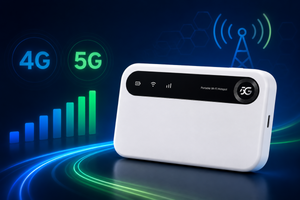
5G has formally launched in Ukraine, but only in the format of a pilot project in limited urban areas. This is not a full commercial deployment of fifth-generation mobile networks for mass users. As of 2026, 5G in Ukraine exists as restricted technical testing with strict frequency, regulatory, security, and energy constraints. For the vast majority of users, 4G LTE remains the primary, stable, and rational mobile internet technology.
What the Phrase “5G Is Already in Ukraine” Actually Means
The statement “5G is already in Ukraine” is correct only with proper technical context. It does not mean nationwide rollout, replacement of 4G, or a fully commercial service. In practice, it refers to a pilot project—limited in geography, number of base stations, and operating modes.
In telecommunications terms, a pilot network is deployed to test equipment, architecture, interoperability with existing infrastructure, and real-world behavior in urban environments. A pilot does not imply guaranteed stability, uniform service quality, or wide availability.
Therefore, using the phrase “5G is already in Ukraine” without adding “in pilot mode” is informationally simplified and technically incomplete.
Timeline of 5G Development in Ukraine
The development of 5G in Ukraine did not begin suddenly in 2026. Some operators report studying the technology for more than six years, with early laboratory or local tests as far back as 2019, applied testing since 2021, internal trials in 2024, and practical urban tests in Lviv between April and October 2025.
The public “launch” in January 2026 is not the beginning of the technology but a formal acknowledgment of a stage where prior testing results were consolidated into a limited city pilot and officially presented as a first step toward future scaling. This distinction is critical when assessing the real state of 5G.
Legal and Technical Status of the Launch
The announced launch is not commercial. It is not accompanied by dedicated tariffs, mass coverage, or mandatory support for all compatible devices. Legally and technically, it is a test network operating within permitted spectrum limits, under wartime security constraints and priorities.
A commercial mobile network launch implies stable coverage across a significant area, standardized access conditions, clear device requirements, customer support, and service quality control. None of these elements are fully implemented for 5G in Ukraine as of 2026.
Frequencies as the Key Limiting Factor
Globally, full-scale 5G operation requires simultaneous use of at least two frequency bands—a low band and a mid band. In Ukraine, these are 700 MHz and 3500 MHz.
The 700 MHz Band
The 700 MHz band is essential for coverage. It enables large cell radius, better indoor penetration, and fewer base stations per area. Without it, 5G becomes a localized, dense, and infrastructure-heavy technology.
As of 2026, only about 20 MHz of spectrum in this band is available in Ukraine. This is insufficient for three mobile operators. To enable real scaling, at least an additional 10 MHz must be cleared, ideally more. Until then, nationwide 5G coverage is technically unrealistic.
The 3500 MHz Band
The 3500 MHz band provides capacity and high data rates. It is responsible for peak and average speeds that define 5G performance in dense areas.
Under wartime conditions, this band is critically constrained due to defense, electronic warfare, and air defense requirements. This is why a full 5G rollout is officially tied to the end of martial law. As long as these constraints remain, 5G can only exist in localized pilot form.
What Type of 5G Is Used in the Pilot
Current pilot zones operate using NSA (Non-Standalone) architecture. In this setup, 4G LTE remains the anchor network, while 5G functions as an overlay for data transmission.
This means latency remains close to 4G levels, full network slicing is unavailable, and most scenarios associated with “pure” 5G cannot be realized. Standalone (SA) architecture, which unlocks the full potential of 5G, is neither technically nor regulatorily deployed in Ukraine as of 2026.
Speeds: Peak Figures vs Real-World Conditions
Pilot tests recorded peak download speeds exceeding 2.4 Gbps. Operators explicitly note that these results were achieved under minimal network load, for a single user, and under ideal radio conditions.
In real urban operation, mobile internet speed depends on available spectrum width, the number of active users per sector, device capabilities, radio propagation, and transport network capacity. Therefore, peak figures should not be interpreted as guaranteed user experience.
For comparison, well-optimized 4G LTE in the 1800 MHz and 2600 MHz bands routinely delivers tens to over one hundred megabits per second, fully meeting most user needs in 2026.
Latency and Stability
Lower latency is often cited as a key advantage of 5G. In theory this is correct, but in NSA pilot deployments the effect depends on implementation and may not differ dramatically from optimized 4G. For critical infrastructure, predictable and stable connectivity remains more important than maximum speed.
Tariffs and the Absence of Surcharges
During the pilot phase, operators report no changes to tariffs. Access to 5G is provided within existing 4G plans without extra charges. This is not a marketing decision but a technical and product necessity. Without stable coverage, guaranteed quality, and mass availability, consumer-level monetization of 5G is unjustified.
Future offerings may appear for business or specialized use cases, but these represent a different market segment.
Energy Consumption and Operation During Power Outages
5G equipment consumes more power than 4G. During extended power outages, operators must prioritize basic connectivity. Even with backup power systems, 5G may be limited or shut down earlier than 4G, which remains the backbone for population and critical services.
User Devices as a Limiting Factor
Even where pilot zones exist, not all subscribers can use 5G. Less than one third of users have compatible devices. This further limits mass adoption in 2026.
Why Ukraine Actually Needs 5G
The real value of 5G lies in the B2B segment: industrial automation, private enterprise networks, IoT, logistics, manufacturing, and critical infrastructure. These use cases require capacity, low latency, and network control. For everyday consumers, the difference between high-quality 4G and pilot-stage 5G remains minimal.
Technical Assessment of the Current State
As of January 12, 2026, 5G in Ukraine exists as a limited pilot project. It is an important strategic step and a necessary phase of preparation, but not a technological revolution for users today. Until martial law ends, sufficient spectrum is released, and full SA architecture is deployed, 4G LTE will remain the core mobile internet technology in Ukraine.
For this reason, investments in 4G equipment, external LTE antennas, and routers in 2026 are technically sound, rational, and fully justified based on the actual state of mobile networks.