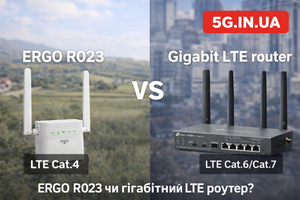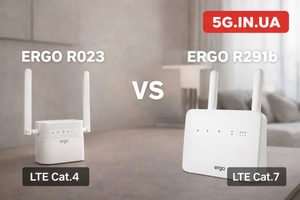
ERGO R023 is not suitable for users who require stable 300–1000 Mbps speeds, ultra-low latency for competitive gaming, or daily transfer of very large data volumes. It is a 4G LTE Cat.4 router with a theoretical maximum of up to 150 Mbps download speed, and its performance depends on signal quality and base station load. If you already have stable fiber internet, require gigabit throughput, or operate a complex corporate network with VLANs and advanced routing, ERGO R023 is not the optimal solution. However, for most residential, backup, and mobile scenarios, it remains a practical and rational tool.
What ERGO R023 Is from a Technical Perspective
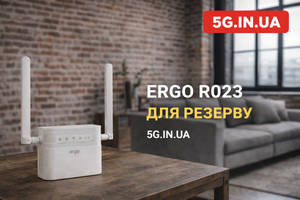
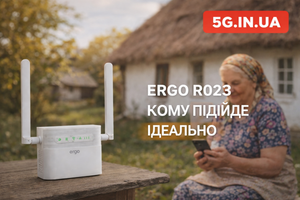
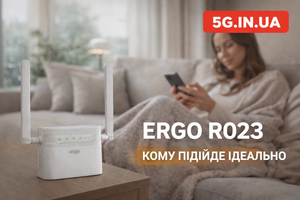
ERGO R023 is a 4G LTE Wi-Fi router, LTE Category 4.
Key specifications:
-
LTE Cat.4 — up to 150 Mbps download, up to 50 Mbps upload
-
Wi-Fi 2.4 GHz
-
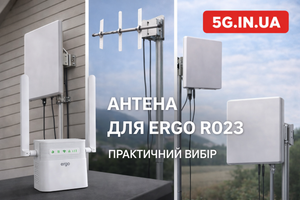
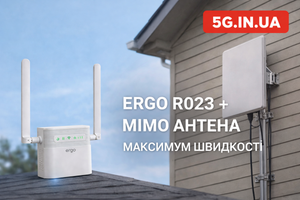
2× SMA connectors for external LTE MIMO antennas
-
WAN/LAN port
-
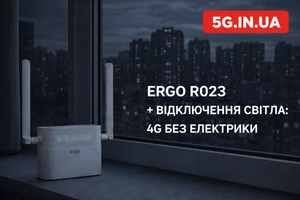
4000 mAh built-in battery
-
Compatible with Ukrainian mobile operators
This means the device operates over a 4G mobile network and depends entirely on radio conditions.
1. If You Need Gigabit Speeds — ERGO R023 Is Not for You
Constant Work with Large Files
If you:
-
regularly download tens or hundreds of gigabytes,
-
work with cloud-based video editing,
-
synchronize large datasets daily,
then 150 Mbps is a limiting factor.
Fiber internet at 500–1000 Mbps will objectively be faster and more stable.
Server-Oriented Scenarios
ERGO R023 is not designed for:
-
hosting a public server,
-
acting as a permanent VPN hub for dozens of users,
-
data center–level tasks.
2. Competitive Gaming and Ultra-Low Latency
4G LTE typically delivers 25–50 ms latency under good conditions.
For most tasks, this is acceptable.
But if you require:
-
5–10 ms latency,
-
zero radio fluctuations,
-
minimal jitter,
then fiber optic internet is the better choice.
3. Locations with Extremely Weak Signal
ERGO R023 supports 2× SMA external antennas, which is a strong advantage.
However, if:
-
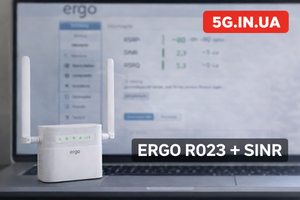
RSRP is below −110 dBm,
-
SINR is near zero or negative,
-
the base station is heavily congested,
then even with an external antenna, performance may remain unstable.
In such conditions, either a different operator or fixed-line internet may be necessary.
4. If You Need 5 GHz or Wi-Fi 6
ERGO R023 operates only on 2.4 GHz Wi-Fi.
This means:
-
better coverage range,
-
but lower throughput compared to 5 GHz networks.
If you have:
-
congested 2.4 GHz spectrum,
-
30–40 active devices,
-
high internal LAN transfer requirements,
then a router with AC or AX Wi-Fi standards would be more appropriate.
5. Complex Corporate Network Infrastructure
ERGO R023 is a consumer-level 4G router.
It is not intended for:
-
complex VLAN configurations,
-
advanced routing scenarios,
-
centralized management of multiple access points,
-
Layer 3 enterprise architecture.
Large office environments require different equipment classes.
6. Full Replacement of Stable Fiber Internet
If you already have:
-
stable GPON fiber,
-
UPS-backed networking equipment,
-
real-world speeds of 500–1000 Mbps,
then ERGO R023 will not deliver higher performance.
It can serve as a backup, but not as a faster primary channel.
7. Data Plans with Strict Traffic Limits
4G performance depends on the operator’s tariff plan.
If your plan includes:
-
100–200 GB traffic caps,
-
speed throttling after a certain usage threshold,
then fixed broadband is more cost-effective for heavy data consumption.
Limitations
-
LTE Cat.4 — theoretical maximum of 150 Mbps.
-
Speed depends on base station load.
-
4G performance depends on signal quality (RSRP, SINR).
-
Wi-Fi limited to 2.4 GHz.
-
Not designed for complex enterprise networks.
-
Traffic is limited by the mobile operator’s data plan.
Who ERGO R023 Still Makes Sense For
Paradoxically, the list of users it suits is larger.
ERGO R023 is rational for:
-
private houses without fiber access,
-
country homes,
-
small offices,
-
backup internet channel,
-
operation during power outages,
-
rental properties,
-
temporary sites and installations.
The 4000 mAh battery and 2× SMA MIMO antenna support make it practical in unstable environments.
Conclusion
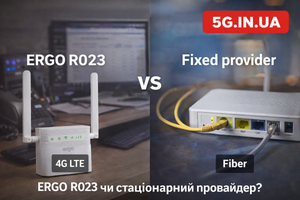
ERGO R023 is not a universal replacement for gigabit fiber internet.
It is not built for data centers, competitive gaming, or large-scale enterprise networking.
But it is built for stability, autonomy, and flexibility.
If you need gigabit speeds — choose fiber.
If you need control, mobility, and reliable backup connectivity — ERGO R023 is a rational solution.
At 5G.IN.UA, ERGO R023 is available individually or as part of ready-to-use 4G kits with properly selected MIMO antennas tailored to specific reception conditions.
FAQ
Is ERGO R023 suitable for 4K streaming?
Yes, if signal quality is stable and real-world speeds exceed 25–30 Mbps.
Can ERGO R023 be used as primary internet?
Yes, if 4G coverage in your location is stable.
Is ERGO R023 suitable for a large office?
No, larger corporate networks require more advanced equipment.
Can I connect an external antenna?
Yes, the 2× SMA connectors support MIMO antennas.
Will 4G remain stable in the evening?
Speeds may decrease due to higher base station congestion.
Does ERGO R023 work during power outages?
Yes, thanks to the built-in 4000 mAh battery.
Can ERGO R023 replace gigabit internet?
No. It is limited by LTE Cat.4 and depends on the mobile network conditions.
ERGO R023 is not the right choice for everyone.
Understanding who it is not suitable for allows you to make a technically justified decision.