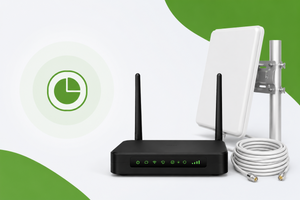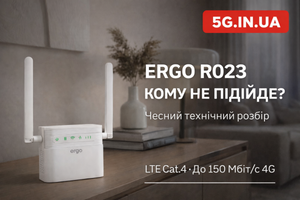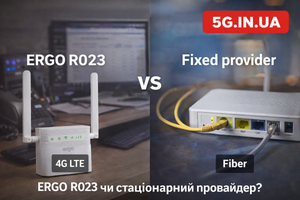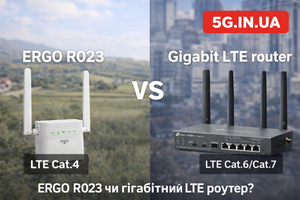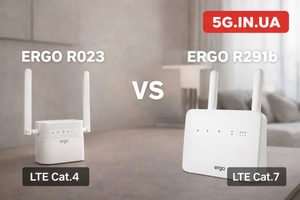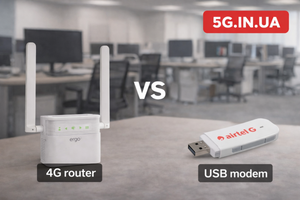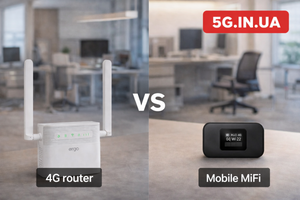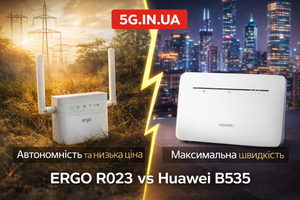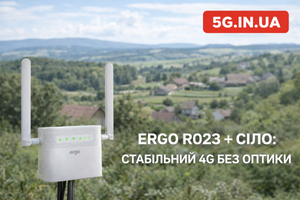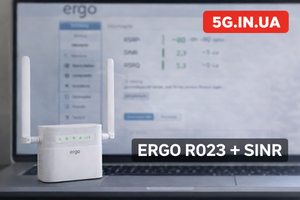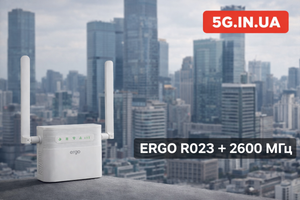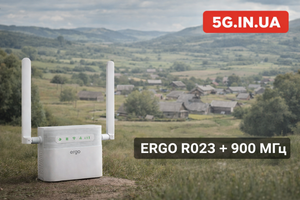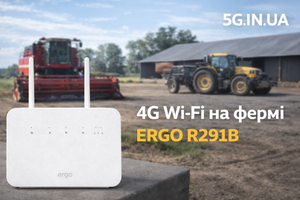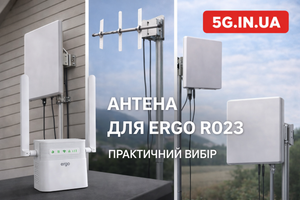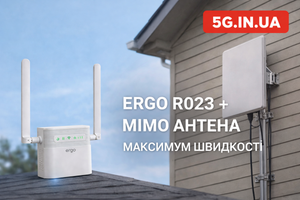
ERGO R023 combined with the Mobile Guard LTE Band 3 1800 MHz 10 dBi antenna + 10 m cable is an optimal configuration for most urban and suburban environments in Ukraine. The 1800 MHz band (Band 3) provides a balance between coverage and capacity, while LTE Cat.4 in ERGO R023 allows speeds up to 150 Mbps under good SINR conditions. A 10 dBi antenna is sufficient to stabilize the signal at the edge of coverage or in dense urban environments when properly installed and cable losses are minimized. This setup improves SINR, reduces reconnections, and extracts maximum performance from Band 3 without excessive directivity that may negatively affect performance in cities. It is a technically balanced solution for ERGO R023 when the primary LTE network operates on 1800 MHz.
Why 1800 MHz Is the Key Band for ERGO R023
ERGO R023 supports LTE FDD 900 / 1800 / 2600 MHz. Among them, Band 3 (1800 MHz) is the most versatile in Ukraine.
Reasons:
-
Used by all major operators
-
Wider bandwidth than 900 MHz
-
Higher achievable speeds than 900 MHz
-
More stable indoor performance than 2600 MHz
1800 MHz represents a compromise between range and throughput.
Since ERGO R023 is LTE Cat.4 without carrier aggregation, selecting the correct working band is critical. In most real-world cases, that band is Band 3.
Technical Logic: How ERGO R023 Works on 1800 MHz
LTE Cat.4 Without Carrier Aggregation
ERGO R023 is LTE Cat.4:
-
Up to 150 Mbps download
-
Up to 50 Mbps upload
-
No carrier aggregation
This means total performance depends on the quality of a single LTE channel.
If that channel is 1800 MHz with good SINR, the router operates close to its theoretical maximum.
Why 1800 MHz Often Outperforms 2600 MHz in Practice
2600 MHz (Band 7):
-
Higher theoretical capacity
-
Poorer wall penetration
-
Smaller coverage radius
1800 MHz:
-
More stable indoor reception
-
Lower attenuation
-
Less dependent on line-of-sight
For ERGO R023 typically used indoors, 1800 MHz delivers more predictable results.
Mobile Guard LTE Band 3 1800 MHz 10 dBi + 10 m Cable: Why It’s Balanced
This antenna is optimized specifically for 1800 MHz.
Advantages of a Narrowband Antenna
-
Higher efficiency at target frequency
-
Better real-world gain
-
Fewer compromises compared to broadband antennas
10 dBi is moderate directional gain.
It is sufficient for:
-
Urban buildings
-
Suburban houses
-
2–7 km distance to the base station
Impact of 10 Meters of Cable
10 meters of coax at 1800 MHz typically results in:
-
2.5–4 dB loss (depending on cable type)
If antenna gain is 10 dBi, effective gain after cable loss:
≈ 6–7 dB net improvement
This is enough to:
-
Increase SINR from 5 dB to 12–15 dB
-
Reduce modulation errors
-
Enable 64-QAM instead of 16-QAM
Result: 1.5–2× speed increase in borderline conditions.
Practical Scenario #1: Dense Urban Area
Initial parameters:
-
RSRP: -98 dBm
-
SINR: 6 dB
-
Speed: 18–25 Mbps
After installing Mobile Guard 1800 10 dBi:
-
RSRP: -88 dBm
-
SINR: 14 dB
-
Speed: 40–70 Mbps
In this scenario, ERGO R023 operates near optimal LTE Cat.4 conditions.
Practical Scenario #2: Suburban Area, 5 km to Base Station
Before antenna:
-
Frequent reconnections
-
Speed fluctuations
After installation:
-
Stable LTE channel
-
Fewer drops
-
Predictable throughput
1800 MHz performs more consistently than 2600 MHz at this distance.
When 1800 MHz Is Not Optimal
-
If the operator mainly uses 900 MHz
-
If distance exceeds 10–12 km
-
If the sector is overloaded
In such cases, an antenna cannot fully solve the limitation.
Limitations of ERGO R023 + 1800 MHz Setup
-
LTE Cat.4 without carrier aggregation
-
Maximum 150 Mbps theoretical limit
-
Base station congestion dependency
-
2.4 GHz Wi-Fi may become a bottleneck
-
10 m cable reduces part of the gain
The antenna improves the RF link but does not change network architecture.
Why 10 dBi Instead of 17–21 dBi?
In urban environments, excessive directivity:
-
Complicates alignment
-
Becomes unstable with reflections
-
Narrows the reception sector
10 dBi is a technically correct compromise.
Is a MIMO Antenna Required for ERGO R023?
ERGO R023 supports 2×2 MIMO.
For maximum performance:
-
Two signal paths
-
Dual polarization
Even a single high-quality 1800 MHz antenna can stabilize weak signals, but full 2×2 MIMO delivers better throughput.
Engineering Summary
Optimal scenario for ERGO R023 in typical Ukrainian conditions:
-
Primary band — 1800 MHz
-
10 dBi directional antenna
-
Up to 10 m quality cable
-
Proper alignment toward the base station
This configuration extracts maximum LTE Cat.4 performance without unnecessary overinvestment.
Conclusion
ERGO R023 + Mobile Guard LTE Band 3 1800 MHz 10 dBi is a technically balanced solution for urban and suburban deployment. The 1800 MHz band offers the best compromise between coverage and speed, while 10 dBi provides sufficient gain without excessive narrow beamwidth.
If your local LTE network primarily operates on 1800 MHz, this configuration allows you to extract maximum performance from ERGO R023 without upgrading to more expensive Cat.6 devices.
Current ERGO R023 kits and Mobile Guard 1800 MHz antennas are available at 5G.IN.UA.
FAQ
1. Does ERGO R023 support Band 3?
Yes, 1800 MHz is fully supported.
2. Does 10 dBi provide real improvement?
Yes, under weak signal conditions speed may increase up to 2×.
3. Is 10 meters of cable acceptable?
Yes, if high-quality low-loss coaxial cable is used.
4. Should I choose 21 dBi instead?
Not necessarily. In cities, higher gain may reduce stability.
5. Does 1800 MHz work in rural areas?
Yes, if the base station is within coverage range.
6. Can Wi-Fi limit speed?
Yes, 2.4 GHz Wi-Fi may become a bottleneck.
7. When should I upgrade to Cat.6?
When carrier aggregation is required and stable speeds above 100 Mbps are needed.