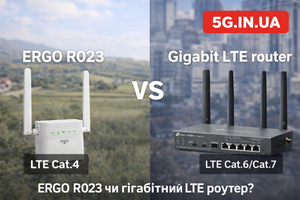
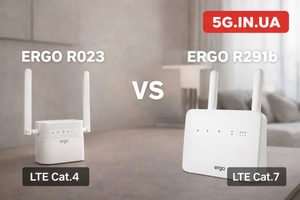
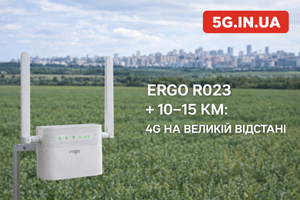
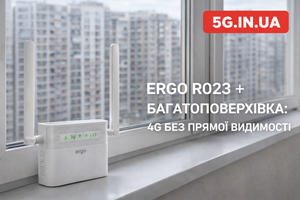
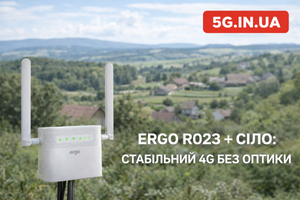
ERGO R023 and 900 MHz (LTE Band 8) make sense when you are located at the edge of coverage, in rural areas, or 5–20 km away from a base station where the main issue is weak signal — not network congestion.
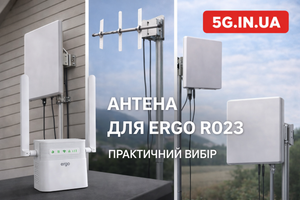
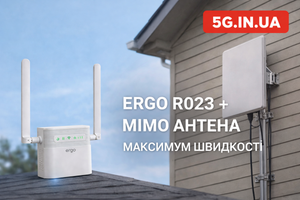
900 MHz provides better propagation and obstacle penetration compared to 1800 or 2600 MHz. Combined with a directional antenna such as Mobile Guard LTE Band 8 900 MHz 15 dBi + 15 m cable, the ERGO R023 (LTE Cat.4, up to 150/50 Mbps) can stabilize connectivity where a smartphone shows 1–2 signal bars and the internet frequently drops.
If you are in a city with strong 1800/2600 MHz coverage, 900 MHz will not increase speed. If you are at the edge of coverage, it is often the only stable option.
What 900 MHz Means in 4G LTE
In 4G LTE, 900 MHz corresponds to Band 8 (FDD-LTE). In practice, operators use it for:
-
Rural coverage
-
Highways and remote areas
-
Indoor coverage in difficult environments
The physics is straightforward:
The lower the frequency:
-
The larger the coverage radius per base station
-
The better the penetration through walls, trees, and terrain
-
The lower the free-space path loss over distance
However:
-
Channel bandwidth is typically smaller
-
Peak throughput is lower
-
The risk of congestion increases under heavy load
Therefore, 900 MHz is not about maximum speed — it is about stable connectivity where higher bands fail.
ERGO R023 Capabilities in the Context of 900 MHz
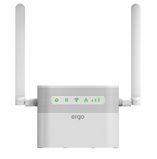
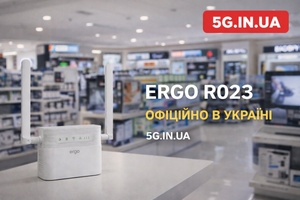
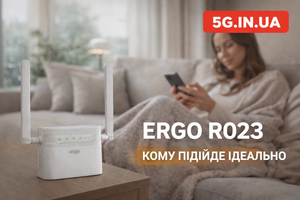
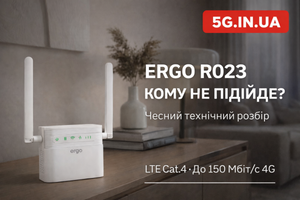
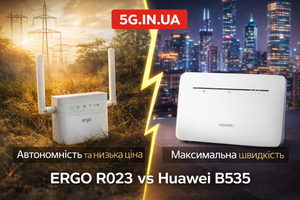
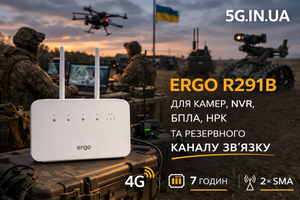
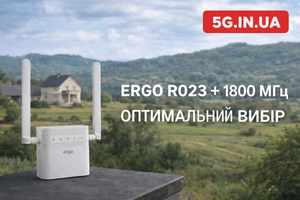
ERGO R023 is an LTE Cat.4 router featuring:
-
Up to 150 Mbps downlink
-
Up to 50 Mbps uplink
-
LTE FDD 900 / 1800 / 2600 MHz support
-
2× SMA Female connectors (MIMO 2×2)
-
Built-in 4000 mAh battery
Important detail:
Cat.4 does not support Carrier Aggregation (CA).
This means:
-
If the base station operates only on 900 MHz, the router works exclusively on Band 8.
-
If 1800 or 2600 MHz are available, it can operate on them separately — but not combine bands.
In rural deployments, this is rarely a limitation. Many remote base stations operate:
-
Either on 900 MHz only
-
Or on 900 + weak 1800
In such conditions, a stable Band 8 connection is preferable to an unstable higher-frequency link.
When 900 MHz with ERGO R023 Truly Makes Sense
1. Distance to Base Station: 5–20 km
Typical scenario:
-
Smartphone shows LTE but RSRP is -105…-115 dBm
-
Speed fluctuates
-
Latency is unstable
Installing a 900 MHz 15 dBi directional antenna can:
-
Improve signal to -85…-95 dBm
-
Increase SINR
-
Stabilize throughput
ERGO R023 then operates predictably and consistently.
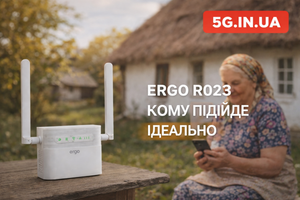
2. Private House or Cottage in Rural Area
In many rural regions, operators provide primary LTE coverage via 900 MHz.
Typical case:
-
1 bar inside the house
-
Better signal outdoors
-
2–5 Mbps indoors
After installing the antenna on a 4–8 m mast:
-
Signal stabilizes
-
Speed increases to 10–30 Mbps
-
Disconnections disappear
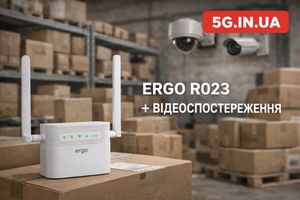
For remote work, video streaming, surveillance systems — this is sufficient.
3. Temporary Locations, Warehouses, Field Operations
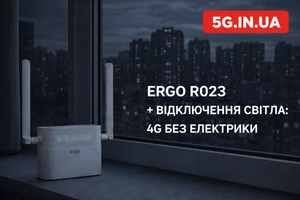
ERGO R023 includes an internal battery.
Combined with 900 MHz, this enables:
-
Backup connectivity
-
Internet without fiber infrastructure
-
Operation via power bank during outages
900 MHz propagates better through metal structures and industrial environments than 1800/2600 MHz.
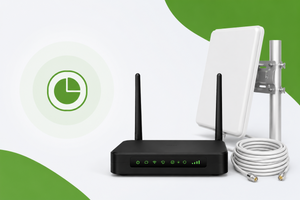
Practical Example: Mobile Guard LTE Band 8 900 MHz 15 dBi + 15 m Cable
This directional antenna is optimized for 900 MHz.
15 dBi gain means:
-
Narrow radiation pattern
-
Focus on a specific base station
-
Up to +15 dB signal improvement
In practice:
If RSRP without antenna is -110 dBm,
with antenna it may improve to -90 dBm or better.
The 15 m cable allows:
-
Roof installation
-
Mast mounting
-
Placement beyond thick walls
At 900 MHz, 15 meters of cable is an acceptable trade-off between distance and attenuation. At 2600 MHz, such cable length would cause significantly higher losses.
Engineering Logic: Why 900 MHz Performs Better at Distance
Wavelength
-
900 MHz ≈ 33 cm
-
1800 MHz ≈ 16.5 cm
-
2600 MHz ≈ 11.5 cm
Longer wavelengths:
-
Diffract better around obstacles
-
Experience lower attenuation over distance
At 10–15 km:
-
2600 MHz often fails
-
1800 MHz becomes weak
-
900 MHz remains usable
Free Space Path Loss
Free Space Path Loss increases with frequency.
The difference between 900 and 1800 MHz is approximately 6 dB — equivalent to doubling transmitter power.
Thus, 900 MHz has a physical advantage in long-distance scenarios.
Limitations of 900 MHz and ERGO R023
1. Lower Peak Speed
Typical 900 MHz throughput:
-
5–20 Mbps
-
Occasionally up to 30 Mbps
If you require 100+ Mbps — this is not the appropriate solution.
2. Potential Congestion
A single 900 MHz sector may cover a wide area.
During evening hours, speed may decrease due to network load.
An antenna improves signal quality — not base station capacity.
3. Not Optimal for Dense Urban Areas
In cities:
-
Band 3 (1800 MHz)
-
Band 7 (2600 MHz)
are typically more efficient.
If your signal on 1800 MHz is -70 dBm, switching to 900 MHz will likely reduce speed.
4. No Carrier Aggregation
ERGO R023 does not combine 900+1800 MHz.
In cities, this may limit performance.
In rural areas, it is generally not critical.
How to Determine if You Need 900 MHz
You likely need Band 8 if:
-
Your phone shows LTE Band 8.
-
Signal strength is -100 dBm or worse.
-
Distance to base station exceeds 5 km.
-
You are in a rural or remote area.
If these conditions apply — 900 MHz is a logical solution.
Recommended Setup
Directional 900 MHz antenna (15 dBi) →15 m cable →SMA ports on ERGO R023 →LTE-only mode (if required) →Precise alignment toward base station →Monitor RSRP / RSRQ / SINR in the web interface.
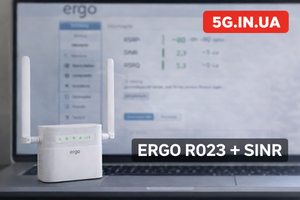
ERGO R023 allows monitoring of radio parameters, which is essential for accurate antenna alignment.
Conclusion
ERGO R023 and 900 MHz are not universal solutions.
They are tools for a specific scenario:
-
Remote location
-
Weak LTE signal
-
Unstable connectivity
-
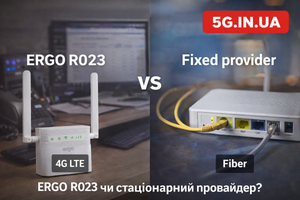
No fiber infrastructure
In such environments, the combination of ERGO R023 and a directional 900 MHz antenna (e.g., Mobile Guard LTE Band 8 15 dBi) provides predictable, stable connectivity.
If your conditions match this scenario, this configuration is a technically justified solution. Full specifications and compatibility details are available at 5G.IN.UA.
FAQ
1. Will 900 MHz provide higher speed than 1800 MHz?
No. 900 MHz improves coverage and stability, not peak speed.
2. Does ERGO R023 support 900 MHz?
Yes. It supports LTE FDD 900 MHz (Band 8).
3. Is a directional antenna required?
If signal is weak and distance is significant — yes. An omnidirectional antenna will not provide comparable gain.
4. Is 15 m cable acceptable?
Yes. For 900 MHz, signal loss over 15 meters is within acceptable limits.
5. Is this solution suitable for city environments?
In most cases — no. 1800 or 2600 MHz are usually more efficient in urban areas.
6. Does MIMO work on 900 MHz?
Yes, if the base station supports MIMO 2×2. ERGO R023 includes two SMA ports.
7. Can this be used as backup internet?
Yes. The built-in battery allows operation as a backup LTE connection.