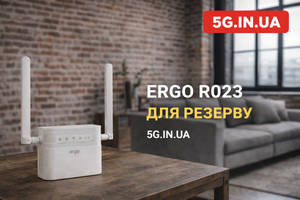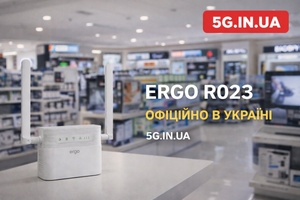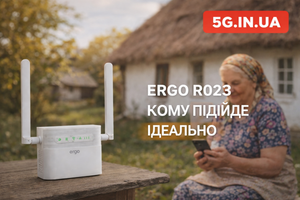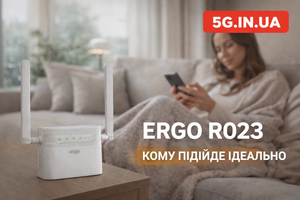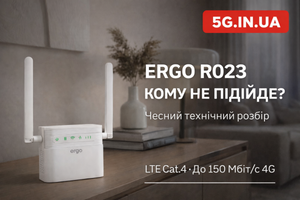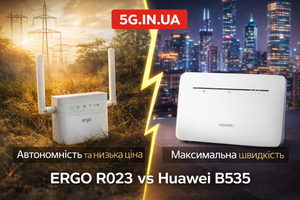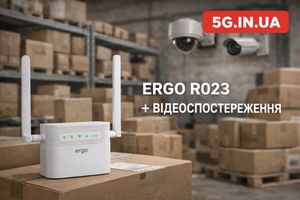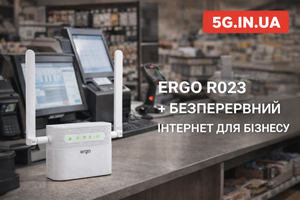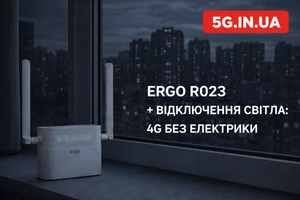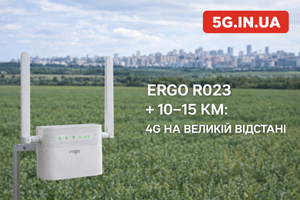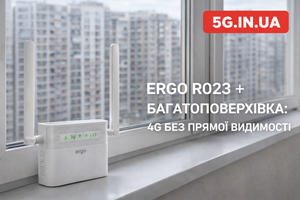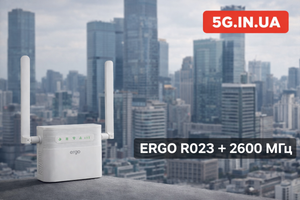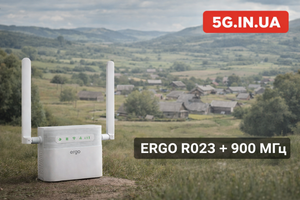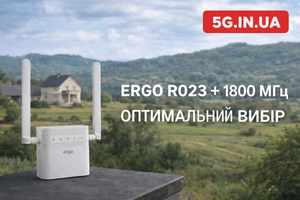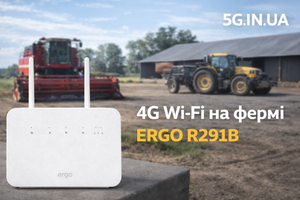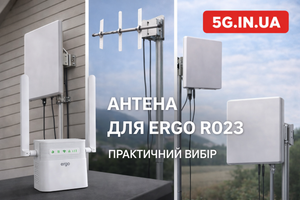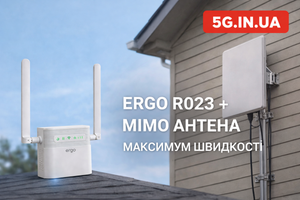
If there is no fiber internet in a village or wired internet is unstable, ERGO R023 allows you to build a predictable 4G connection using a SIM card. It is an LTE Cat.4 router (up to 150/50 Mbps) with MIMO 2×2 support and two SMA connectors for an external antenna. Stability depends not on “signal bars” but on proper band selection (900 / 1800 / 2600 MHz), correct external antenna installation, and monitoring RSRP / RSRQ / SINR in the engineering menu (192.168.1.1 → Internet → Engineering Information). With proper antenna alignment and reasonable base station load, you can achieve stable internet for video calls, cloud work, online education, and small business — without fiber.
Why 4G in a Village Is About Physics, Not Signal Bars
In cities, base station density is high. In rural areas, a single tower may serve several settlements. Stability depends on:
-
distance to the base station
-
terrain (forests, hills, valleys)
-
LTE band (Band 8 — 900 MHz, Band 3 — 1800 MHz, Band 7 — 2600 MHz)
-
correct antenna installation
-
sector congestion
ERGO R023 does not “create” internet — it extracts maximum performance from available radio conditions.
Technical Foundation: Why ERGO R023 Works in Rural Areas
LTE Cat.4 — Sufficient for Real Tasks
ERGO R023 supports LTE Cat.4 (up to 150 Mbps download and 50 Mbps upload). In rural environments, higher LTE categories often provide no real advantage due to:
-
limited spectrum at the tower
-
distance from the base station
-
absence of carrier aggregation in remote sectors
What matters instead:
-
stable connection
-
consistent upload
-
minimal fluctuations
Cat.4 is often the rational choice.
MIMO 2×2 and Dual SMA Connectors
ERGO R023 includes two SMA connectors, enabling full MIMO 2×2 operation:
-
better resistance to interference
-
improved throughput
-
more stable connection
Both cables must be connected and of equal length.
Engineering Menu for Measured Optimization
Access via:
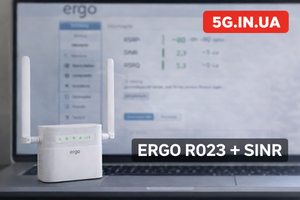
192.168.1.1 → admin/admin → Internet → Engineering Information
You can monitor:
-
RSRP (signal strength)
-
RSRQ (signal quality)
-
SINR (signal-to-noise ratio)
In rural conditions, SINR often determines stability more than raw signal strength.
Choosing the Right Band in a Village
900 MHz (Band 8) — Coverage and Distance
Advantages:
-
larger coverage radius
-
better penetration through obstacles
-
stable connection at 10–20 km
Limitation: smaller channel width → lower peak speeds.
Often the primary rural band.
1800 MHz (Band 3) — Balance
Advantages:
-
better capacity
-
higher speeds if the tower is within 5–10 km
-
widely deployed
Suitable when partial or direct line-of-sight exists.
2600 MHz (Band 7) — Speed Near the Tower
Less common in remote villages.
Provides higher capacity but weaker long-range performance.
Practical Scenario: House 12 km From Tower
Initial conditions:
-
hill between house and tower
-
weak smartphone signal
-
unstable speeds
Solution:
-
Install directional external antenna
-
Connect both cables to ERGO R023
-
Mount at least 1 meter above roof
-
Rotate in 5–10° increments
-
Monitor RSRP and SINR
Typical improvement:
-
RSRP improves from −108 to −92 dBm
-
SINR increases from 3 to 12 dB
-
speed rises from 8 to 35 Mbps
-
upload stabilizes
Proper Antenna Installation in Rural Areas
Core Rules
-
outdoor installation only
-
minimum 1 meter above roof
-
avoid nearby metal structures
-
do not install indoors
In apartments, mounting outside the window is possible as a compromise, but performance decreases.
Magnetic Antenna
In a vehicle:
-
mount at center of metal roof
Stationary:
-
install outdoors
-
preferably on a metal surface
Indoor placement significantly reduces SINR.
Engineering Parameter Guidelines
RSRP
-
good: −80 to −95 dBm
-
acceptable: −95 to −105 dBm
SINR
-
good: >10 dB
-
acceptable: 5–10 dB
-
poor: <5 dB
In rural environments, slightly weaker RSRP with higher SINR is often better.
Real-World Results in a Village
Properly configured ERGO R023 enables:
-
stable video calls
-
cloud-based work
-
online learning
-
IP surveillance cameras
-
backup internet for small business
Limitations to Understand
1. Base Station Congestion
Speed may drop during peak hours.
2. Physical Distance
Beyond 15–20 km, radio physics imposes hard limits.
3. LTE Category Limitation
ERGO R023 is LTE Cat.4 — maximum 150 Mbps.
4. Cable Quality
Long or low-quality cables reduce efficiency.
5. Terrain and Obstacles
Forests, metal roofing, and uneven terrain impact performance.
Why ERGO R023 Is a Rational Rural Choice
-
supports external antennas
-
full MIMO 2×2
-
engineering diagnostics
-
SIM-based operation
-
Ethernet backup capability
-
mechanical power button for controlled restarts
It is a practical connectivity tool, not a basic indoor Wi-Fi device.
Conclusion
Stable 4G without fiber in a village is achievable with proper setup. ERGO R023, combined with a correctly selected and installed external antenna, allows you to maximize available LTE capacity in your location.
Before purchasing, evaluate:
-
distance to base station
-
available LTE bands
-
ability to mount an antenna outdoors
Specifications, compatible antennas, and ready-to-use kits are available at 5G.IN.UA.
FAQ
1. Will ERGO R023 work in a remote village?
Yes, if LTE coverage exists and an external antenna is properly installed.
2. Is an external antenna necessary?
In most rural scenarios — yes.
3. Which band is best for rural areas?
Often 900 MHz for distance, 1800 MHz if the tower is closer.
4. Can speeds exceed 100 Mbps?
Possible under optimal conditions, depending on operator capacity.
5. Can it be used as fiber backup?
Yes, ERGO R023 supports Ethernet connection.
6. Does mounting height matter?
Yes, even 1–2 meters can significantly improve SINR.
7. Is setup complicated?
No. Engineering parameters allow precise tuning.