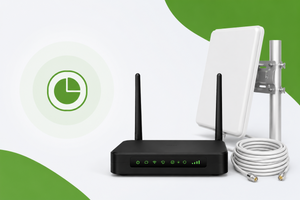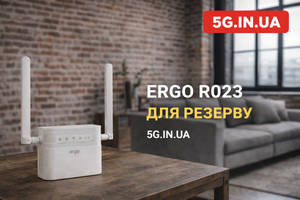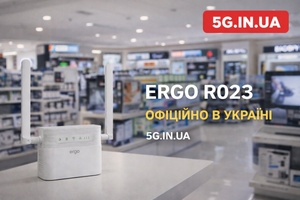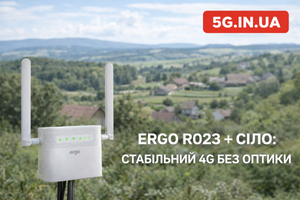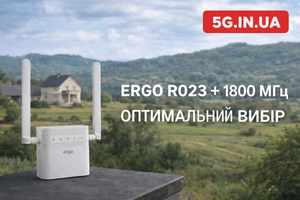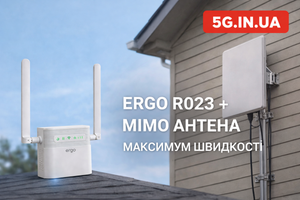
For ERGO R023, you should choose an external LTE MIMO 2×2 antenna with two cables and SMA connectors if the signal is weak or unstable. In urban areas, a 10–15 dBi panel MIMO antenna for 1800/2600 MHz (Band 3/7) is usually sufficient. In rural areas or at the cell edge, directional MIMO antennas with 15–21 dBi gain are more effective. A single antenna does not unlock the full MIMO 2×2 capability of ERGO R023. The correct choice depends not on “maximum dBi,” but on distance to the base station, SINR level, sector load, and cable length. For short cable runs (up to 10 m), quality RG58 or LMR195 can be used. A properly selected antenna can increase real-world speed by 1.5–2× and stabilize the connection, but it does not bypass LTE Cat.4 limitations (up to 150/50 Mbps).
Why Antenna Selection Is Critical for ERGO R023
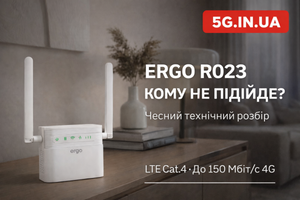
ERGO R023 is an LTE Cat.4 router with 2×2 MIMO support and two SMA Female connectors. This means:
-
The device has two independent RF chains
-
It supports spatial diversity
-
It performs best with two antennas
Without the proper antenna, ERGO R023 works — but it does not reach its full LTE modem potential.
Important: an antenna does not “create” speed. It improves signal quality, allowing the network to use higher modulation schemes.
What Parameters Actually Matter
1. MIMO 2×2
ERGO R023 supports 2×2 MIMO. Therefore:
-
Two signal paths are required
-
Dual polarization ±45°
-
Two separate cables
One antenna = one spatial stream = lower throughput.
2. Frequency Bands
ERGO R023 supports:
-
Band 3 (1800 MHz)
-
Band 7 (2600 MHz)
-
Band 8 (900 MHz)
Urban areas typically use 1800 and 2600 MHz.
Rural areas often rely on 900 MHz.
The antenna must support the required frequency bands.
3. Gain (dBi)
dBi does not equal speed — it reflects directionality.
10–12 dBi → urban areas
15–17 dBi → suburban
17–21 dBi → remote areas
Excessive gain in dense urban environments may reduce stability due to narrow beamwidth.
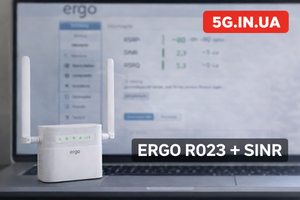
4. SINR Is More Important Than RSRP
RSRP shows signal strength.
SINR shows signal quality.
For LTE Cat.4:
-
SINR < 5 dB → low speed
-
10–15 dB → stable mid-range
-
20 dB → maximum Cat.4 efficiency
A properly selected antenna primarily improves SINR.
Types of Antennas for ERGO R023
Panel MIMO Antenna
Best option for urban environments.
Advantages:
-
Compact
-
Easy to install
-
Stable performance
Recommended gain: 10–15 dBi.
Directional Yagi MIMO
Suitable for remote areas.
Advantages:
-
Narrow beam
-
Higher gain
Drawback:
-
Requires precise alignment.
Wideband MIMO
Covers multiple LTE bands.
A universal solution if the operator uses different frequencies.
Cable: An Underrated Factor
10 meters of RG58 may introduce 3–4 dB loss at 1800 MHz.
3 dB loss = half the signal power.
Rules:
-
Keep cable length minimal
-
Use quality low-loss coax
-
Avoid unnecessary adapters
Otherwise, even a 21 dBi antenna may not deliver real improvement.
Practical Scenarios
Scenario 1: Urban Apartment, Weak Signal
Problem:
RSRP -100 dBm, SINR 5 dB
Solution:
10–15 dBi panel MIMO antenna.
Result:
SINR increases to 12–18 dB
Speed improves from 20 to 40–60 Mbps.
Scenario 2: Rural Area, 6–10 km from Base Station
Problem:
RSRP -110 dBm
Solution:
17–21 dBi directional MIMO antenna.
Result:
Stable LTE instead of periodic dropouts.
Scenario 3: Congested Base Station
An antenna will not solve this.
The limitation is on the operator’s side.
When You Should Not Install a High-Gain Antenna
-
Strong signal (RSRP better than -80 dBm)
-
SINR above 20 dB
-
Low speed due to sector congestion
In these cases, an antenna will not significantly improve performance.
Limitations
-
ERGO R023 is LTE Cat.4 (up to 150/50 Mbps)
-
No carrier aggregation
-
Dependent on base station load
-
2.4 GHz Wi-Fi may become a bottleneck
-
Incorrect installation eliminates benefits
An antenna improves the radio link but does not override network constraints.
How to Know You Need an Antenna
Check ERGO R023 engineering menu:
-
RSRP worse than -95 dBm
-
SINR below 10 dB
-
Frequent disconnections
These indicate the need for an external MIMO antenna.
Why ERGO R023 Is Designed for External Antennas
-
Two SMA ports
-
Full 2×2 MIMO support
-
Works on 900 / 1800 / 2600 MHz
-
Delivers real improvement when properly installed
ERGO R023 is structurally designed to operate with external antennas.
Conclusion
Choosing an antenna for ERGO R023 is an engineering decision — not about buying the most expensive model.
Urban → 10–15 dBi panel MIMO.
Rural → 17–21 dBi directional MIMO.
Always → two lines for full 2×2 MIMO.
A properly selected antenna allows you to extract maximum speed and stability from LTE Cat.4, but it does not bypass network physics or base station congestion.
If you need assistance selecting the right antenna based on your signal conditions and distance to the base station, suitable solutions for ERGO R023 are available at 5G.IN.UA.
FAQ
1. Can I connect only one antenna to ERGO R023?
Yes, but full 2×2 MIMO performance will not work.
2. Which antenna is better — 15 or 21 dBi?
It depends on distance to the base station and environment.
3. Does ERGO R023 support 900 MHz?
Yes, Band 8 is supported.
4. Can an antenna double my speed?
It may increase speed by 1.5–2× in weak signal conditions.
5. Can I install the antenna indoors?
Yes, but performance will be lower.
6. Does cable affect speed?
Yes, cable loss reduces SINR.
7. When should I upgrade to Cat.6?
If you need carrier aggregation and stable speeds above 100 Mbps.