When a business relies on IP telephony, the loss of the main internet connection does not affect “convenience.” It affects the actual work of sales teams, support, logistics, dispatchers, and office staff. If the channel goes down, calls do not go through, managers lose clients, and incoming traffic simply never reaches the team. That is why a backup channel for IP telephony is not an optional extra. It is a normal part of a working communications setup.
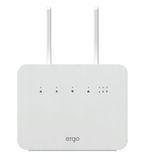
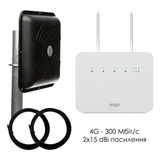
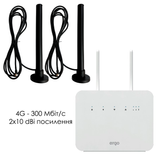
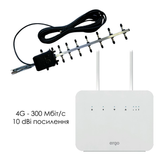
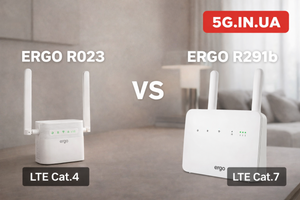
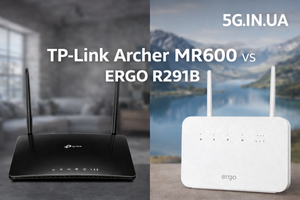
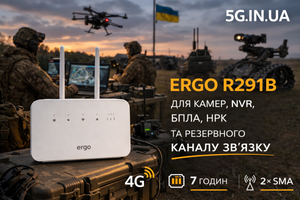
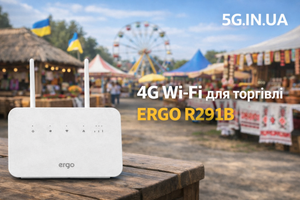
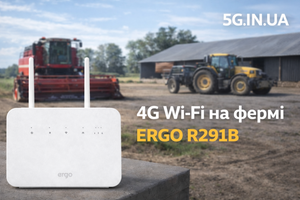
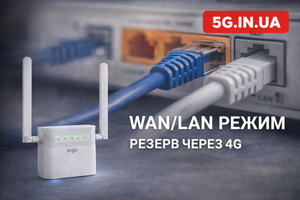
For most small and medium-sized companies, the most practical backup for IP telephony is a dedicated 4G router with a SIM card. ERGO R291B fits this scenario well: it supports LTE Cat.7, two-carrier aggregation 2CA, dual-band AC1200 Wi-Fi, has 1× WAN/LAN and 3× LAN 10/100/1000, 2× SMA for external LTE antennas, and a 4000 mAh battery. The router can operate autonomously for up to 7 hours, which becomes critical when both wired internet and power disappear at the same time. For backup IP telephony, this means one simple thing: communication can be preserved without complex infrastructure, and if LTE is weak, it can be strengthened with an external antenna.
Why IP Telephony Needs a Separate Backup Channel
IP telephony works properly only when the connection is stable. For voice traffic, what matters is not impressive peak megabit figures, but predictable latency, the absence of serious drops, and overall network stability. If the main provider goes down, the entire telephony system can fail within seconds: phones may still appear registered, but calls do not pass; the CRM works partially; a manager seems online, but the client cannot hear them or cannot reach them at all.
For a business, the consequences are obvious.
Loss of Incoming Calls
If a company sells by phone or receives requests through IP telephony, every provider outage means direct loss of incoming leads. A client is not going to analyze why your SIP gateway or cloud PBX is temporarily unavailable.
Disruption of Outgoing Communication
Managers cannot call clients, service teams cannot handle requests, logistics cannot coordinate deliveries, and internal communication between branches or employees breaks down.
Reputation Damage
For a client, “I can’t get through” does not look like a technical issue. It looks like unreliability. In many industries, that alone is enough to lose the customer to a competitor.
What Proper Backup for IP Telephony Actually Means
The wrong scenario is when, in the middle of an outage, someone starts sharing internet from a phone, manually reconnecting laptops, checking whether SIP clients have come back to life, and trying to understand why one desk phone rings and another does not. That is not redundancy. That is emergency improvisation.
A proper backup channel for IP telephony should look different.
It Must Be Ready in Advance
The SIM card, the tested mobile operator, the correct installation point, and the verified telephony connection scheme all need to be prepared before a failure, not after it.
It Must Support the Critical Voice Layer
Not every part of the office is equally important. If the backup is intended for IP telephony, the priority should be IP phones, managers’ laptops, access to the cloud PBX, CRM, and basic browser work.
It Must Not Depend on the Same Wired Path
If the main channel is fiber or Ethernet from a local provider, a 4G backup physically separates the risks. That is where its real value lies.
Why 4G Works as a Backup Channel for IP Telephony
For many companies, 4G is the most rational form of backup. Not because it is “cheap,” but because it is a fast, independent, and practical way to preserve communication.
Separate Infrastructure
The mobile network does not depend on the same fiber line that failed in your office, store, or service location. This means a provider outage does not necessarily destroy the backup at the same moment as the main channel.
Sufficient Capacity for Voice
ERGO R291B supports LTE Cat.7 up to 300 Mbps download and 100 Mbps upload, along with 2CA. For IP telephony, this matters not as a peak marketing figure, but as headroom so that voice traffic does not become a bottleneck even when CRM, browser work, email, or several work messengers are running in parallel.
Fast Deployment Without Cable Installation
For a backup solution, not only performance matters, but also how quickly it can be implemented. A 4G router does not require a separate provider entry, new cabling, or complicated approvals. In many cases, a SIM card, proper placement, and advance testing are enough.
Why ERGO R291B Fits Backup IP Telephony Specifically
ERGO R291B does not feel like a “travel mobile router” that somehow ended up in an office. Its configuration is much closer to a real working task.
1× WAN/LAN + 3× LAN 10/100/1000
For IP telephony, this is one of the key points. SIP phones, a mini-PBX, an administrator’s laptop, a separate switch, or a manager’s PC are often better connected by cable rather than forcing the entire voice layer to rely only on Wi-Fi. The presence of gigabit LAN ports makes R291B not just a “4G hotspot,” but a full backup network node.
Dual-Band AC1200 Wi-Fi
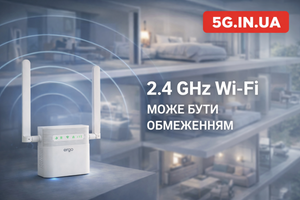
If part of the team uses softphones on laptops or smartphones, dual-band Wi-Fi provides more flexibility. 2.4 GHz may be useful for range, while 5 GHz is better for lower interference and more stable operation in an office crowded with neighboring networks. For voice traffic, that is not a trivial detail.
2× SMA for External LTE Antennas
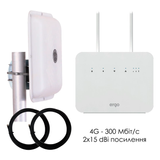
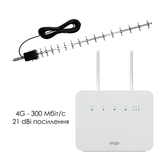
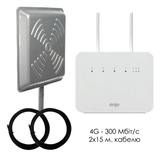
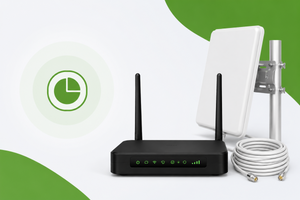
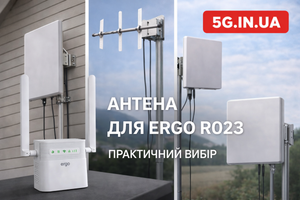
For backup telephony, weak LTE is a real problem. Not because “speed is lower than desired,” but because voice does not tolerate an unstable connection. If the premises are deep inside a building, on a lower floor, in an older structure, in dense urban development, or in a business center with difficult glass, connecting an external MIMO antenna through 2× SMA can radically improve the situation.
Autonomous Operation for Up to 7 Hours
ERGO R291B has a 4000 mAh battery and can operate autonomously for up to 7 hours. For a backup telephony channel, this is a strong advantage: if both the provider and the power supply fail, the channel does not die immediately. Provided that IP phones, laptops, or the mini-PBX also have backup power, voice communication can be maintained for hours rather than minutes.
Practical Use Cases
Sales Department on a Cloud PBX
Managers make calls through SIP clients or IP phones, leads go into the CRM, and the main channel is a standard provider connection. If it fails, ERGO R291B becomes the backup through which the team does not lose the working day and does not lose incoming calls.
Small Office With 3–10 Employees
In this environment, a backup 4G channel often looks ideal. A few IP phones, several laptops, browser work, CRM, messengers, and a cloud PBX can realistically stay online on backup without complicated infrastructure.
Dispatch, Service, or Logistics Point
Where calls are not just a convenience but an operational foundation, communication failure is expensive. In this scenario, R291B is useful precisely as a fast, independent, and technically sufficient backup.
Store or Service Point With an IP Phone and Payment Terminal
If a location simultaneously needs telephony, browser work, payments, and basic office functionality, one 4G router with LAN ports and an external antenna looks far more logical than sharing internet from a phone.
How to Build a Backup Channel for IP Telephony Properly
1. Define the Priority Layer
The backup should not carry everything indiscriminately. You need to isolate the critical devices: SIP phones, managers’ laptops, CRM, browser access, cloud PBX, and perhaps one terminal or key workstation.
2. Test Operators Before an Outage Happens
At a given location, one mobile operator may provide noticeably better stability than another. For IP telephony, that matters more than abstract “average city speed.”
3. Place the Router Where LTE Is Better
Not in a signal-dead server cabinet and not under a desk “so it stays out of the way,” but closer to a window, an external wall, or a spot where the channel is genuinely more stable.
4. Do Not Ignore an External Antenna
If LTE indoors is weak or unstable, an external MIMO antenna often brings more benefit than hoping that “it will somehow work out.” For voice, this is critical.
5. Use Ethernet for Voice Nodes
A SIP phone, mini-PBX, key workstation, or switch should be connected by cable. That is exactly why R291B has the right set of LAN ports.
Honest Limitations: When 4G Backup for IP Telephony May Not Be Suitable
4G as a backup channel for telephony is a strong solution, but not a magical one.
Very Weak LTE Signal
If there is almost no mobile coverage inside the premises, a router alone will not save the situation. In that case, you need either an external antenna, another operator, or a different connection strategy.
Heavily Overloaded Base Station
During peak hours or large-scale outages, the mobile network itself may degrade. In that case, the backup is still far better than nothing, but expectations must remain realistic.
The Mistaken Desire to Put Everything on the Backup
If the same 4G link is expected to carry heavy video conferencing, backups, large downloads, high-bitrate cameras, and the full IP telephony stack at once, the channel may degrade. The backup should primarily preserve voice and critical operations.
No Backup Power for Other Nodes
The router itself can work autonomously for up to 7 hours, but if the IP phones, switch, PoE equipment, or mini-PBX lose power, the overall scheme still fails. A backup must be thought of as a system, not as a single box.
Why ERGO R291B Looks Like a Balanced Choice
The market contains either very simple mobile routers that are poorly suited for a working voice layer, or more expensive solutions that are excessive for small and medium-sized businesses. ERGO R291B sits in a reasonable middle ground.
It provides exactly the set that makes sense for backup IP telephony:
-
LTE Cat.7 and 2CA
-
AC1200 Wi-Fi 2.4 / 5 GHz
-
1× WAN/LAN + 3× LAN 10/100/1000
-
2× SMA for external LTE antennas
-
4000 mAh battery
-
autonomous operation for up to 7 hours
-
support for up to 32 users
That does not mean it will automatically solve every scenario without setup. But for the task of a backup channel for IP telephony, its configuration looks technically logical and grounded.
Conclusion
A backup channel for IP telephony is not about “being prepared just in case.” It is about preserving the working voice layer at the exact moment when the main provider fails. If a business sells, supports, coordinates, or receives requests by phone, an internet outage directly affects money and reputation.
In that scenario, 4G backup is one of the most practical approaches. And ERGO R291B fits well precisely because it combines LTE Cat.7, gigabit LAN ports, dual-band Wi-Fi, 2×SMA for an external antenna, and autonomous operation for up to 7 hours. If what is needed is not “emergency internet from a phone,” but a proper backup channel for IP telephony, ERGO R291B is one of the options worth serious consideration. You can review the model, compatible antennas, and ready-made solutions in the 5G.IN.UA online store.
FAQ
Is 4G enough as a backup for IP telephony?
Yes, in most small and medium scenarios it is enough. For voice, stability and proper prioritization of the critical layer matter more than peak megabit figures. LTE Cat.7 in ERGO R291B provides solid headroom for voice, CRM, and basic work activity.
Why is ERGO R291B better than internet sharing from a phone?
Because a smartphone is improvisation, while ERGO R291B is a separate network node with 1× WAN/LAN + 3× LAN 10/100/1000, dual-band Wi-Fi, 2× SMA for an antenna, support for up to 32 users, and a built-in 4000 mAh battery.
Can an IP phone or mini-PBX be connected by cable?
Yes. That is exactly why the LAN ports are highly relevant here. Critical voice devices are better connected by Ethernet rather than relying only on Wi-Fi.
Is an external antenna necessary?
Not always. But if the office or point is deep inside a building, on a lower floor, or in a weak coverage area, an external LTE MIMO antenna often sharply improves channel quality. ERGO R291B has 2× SMA specifically for this scenario.
How long can ERGO R291B work without electricity?
The router can operate autonomously for up to 7 hours from its built-in 4000 mAh battery. Actual runtime depends on load, signal quality, and the number of active devices.
When may this type of backup not be suitable?
When the location has almost no LTE, when the base station is overloaded, or when the backup is expected to carry traffic far beyond voice and critical work.
Is ERGO R291B suitable not only for telephony backup?
Yes. Through the same LAN ports and Wi-Fi, it can simultaneously maintain basic access for CRM, browser work, messengers, a payment terminal, or an administrator’s laptop, while IP telephony remains the top priority.