On September 10, 2026, Odesa officially joined Ukraine’s 5G pilot project. Mobile operators Kyivstar, Vodafone, and lifecell opened test access to the fifth-generation network in selected areas of the city. Odesa became the fifth city in Ukraine where users can test 5G in real-world conditions — after Lviv, Borodianka, Kharkiv, and Kyiv.
This is not yet continuous 5G coverage across all of Odesa, but a pilot network. Its purpose is to test equipment, network load, real-world speeds, and the specifics of how the technology operates before the further expansion of 5G in Ukraine.
What speeds does 5G deliver in Odesa
According to the Ministry of Digital Transformation, the average speed in pilot 5G networks is approximately 600–700 Mbps, while during testing, data transfer speeds can exceed 1 Gbps. In total, 340 5G base stations are already operating in Ukraine, and more than 3.8 million unique subscribers have tested the new technology.
The results of individual operators in Odesa are even higher. lifecell reports speeds of up to 1.5 Gbps, while Kyivstar recorded more than 2.4 Gbps during testing. After the network was opened to users, Kyivstar’s average speeds have been approximately 600–800 Mbps.
The actual speed for a specific user will depend on location, operator, base station load, device specifications, and radio signal quality.
Where 5G already works in Odesa
The coverage areas of Kyivstar, Vodafone, and lifecell differ slightly.
Kyivstar opened its test network in the historic center of Odesa — in particular around Prymorskyi Boulevard, the Potemkin Stairs, and the surrounding areas.
lifecell provided 5G coverage in the central part of the city, the Arcadia area, and at Odesa railway station. The test zone includes, among other locations, parts of Derybasivska, Hretska, Preobrazhenska, Rishelievska, Sadova, Hoholia, and other central streets.
Vodafone also launched 5G in central Odesa. The test zone covers areas from Prymorskyi Boulevard and Derybasivska Street to Pryvokzalna Square and Kulykove Pole.
Therefore, 5G can already be tested in different parts of the city center, near the railway station, and in selected popular locations in Odesa.
What frequency does 5G use in Odesa
One of the most important technical parameters when choosing a smartphone or 5G router is the supported frequency band.
The current pilot network in Odesa uses the 3500 MHz frequency, which corresponds to the 5G NR n78 band. The network operates using the 5G NSA (Non-Standalone) architecture — in this configuration, 5G works together with the operator’s existing 4G infrastructure.
Therefore, the word “5G” in a device’s specifications alone is not enough. To use the current test network, it is important that a smartphone, modem, or mobile router supports 5G NR n78 and NSA mode.
What is needed to connect to 5G in Odesa
In most cases, a compatible device connects to 5G automatically after entering the coverage area. A separate tariff plan specifically for 5G is currently not required — mobile traffic is used according to the terms of the operator’s existing tariff plan.
To connect, you need:
- a smartphone, modem, or 5G router with support for the required 5G band;
- an operator SIM card that supports operation in a modern network;
- 5G mode enabled in the device settings;
- up-to-date software;
- to be directly within the test 5G coverage area.
If a compatible smartphone does not connect automatically, the Ministry of Digital Transformation recommends checking the mobile network settings, updating the system, disabling power-saving mode, briefly enabling Airplane Mode, or restarting the device.
5G can be used not only on a smartphone
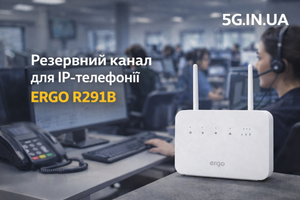
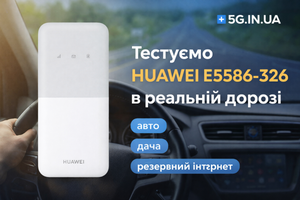
The launch of pilot networks also makes other categories of equipment increasingly relevant — primarily mobile 5G routers, which receive mobile internet from an operator and create their own Wi-Fi network for laptops, smartphones, tablets, and other devices.
This makes it possible to use one mobile connection for several devices at once — at home, in the office, while working outdoors, or in a car.
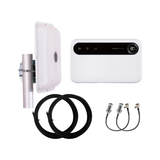
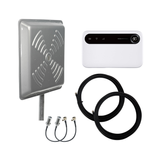
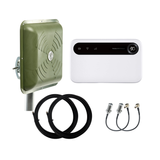
The 5G.IN.UA catalog includes 5G routers and ready-made internet kits based on them, designed for use with Ukrainian mobile operators.
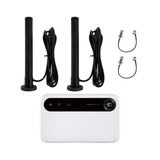
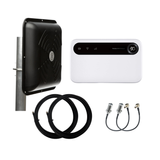
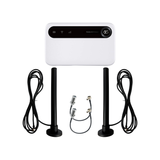
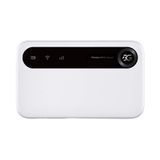
One such option is the 5G/4G Wi-Fi internet kit for a car with ZTE U50 and 2 Mobile Guard Mini antennas. 5G/4G Wi-Fi internet kit with ZTE U50 and 2 Mobile Guard Mini antennas
The kit is based on the ZTE U50 mobile router with support for 4G/5G networks and Wi-Fi 6. According to GCF certification data, this model supports 5G NR n78, as well as 5G EN-DC (NSA) — the technologies used in the current 5G pilot network.
The kit is designed for mobile use: the ZTE U50 creates a Wi-Fi network in the car, while two external Mobile Guard Mini car antennas make it possible to use a ready-made antenna system for supported mobile frequency bands while traveling. (5g.in.ua)
Why the launch of 5G in Odesa is important for Ukraine
The current stage is primarily a large-scale practical test. Operators have the opportunity to test the operation of base stations under real-world load, network behavior in dense urban development, and the operation of a large number of compatible devices.
5G also makes it possible to move part of mobile traffic away from LTE and increase the overall network capacity in places with a high concentration of users. That is why the centers of large cities, transport hubs, and popular public locations are among the first test zones.
Odesa has become another major city on Ukraine’s 5G map. Further expansion of the pilot networks will provide operators with more data to prepare infrastructure for the full-scale deployment of fifth-generation mobile communications in Ukraine.
As of September 10, 2026, 5G in Odesa is operating specifically in test mode, and signal availability depends on the operator and the specific location.