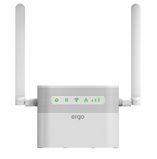
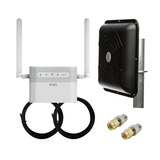
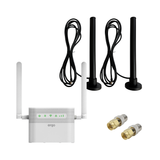
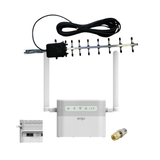
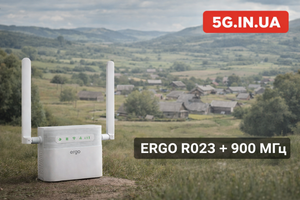
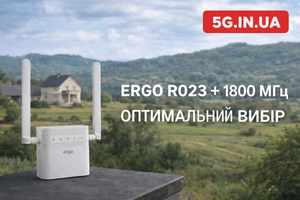
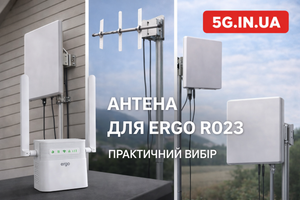
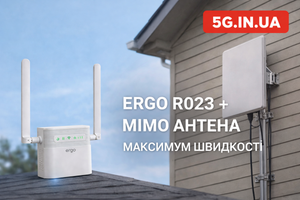
LTE Cat.4 without Carrier Aggregation means that the 4G modem operates on one frequency band at a time and does not combine multiple LTE bands simultaneously. The theoretical maximum speed is up to 150 Mbps download and 50 Mbps upload. This is a stable and mature technology that works well in most real-world scenarios in Ukraine: rural areas, private houses, backup internet setups, offices, and warehouses. The absence of Carrier Aggregation does not mean “slow internet.” It simply means the modem does not merge multiple LTE bands. In practice, speed depends far more on signal quality (RSRP/RSRQ/SINR), base station load, and proper antenna setup than on modem category. This is exactly how the ERGO R023 4G router (LTE Cat.4) operates — delivering stable connectivity without unnecessary complexity.
LTE Cat.4 without Carrier Aggregation – What It Means in Practice
When a router specification says “LTE Cat.4” and does not mention Carrier Aggregation (CA), many users wonder: is this a drawback? Will the speed be enough? Should you choose Cat.6 instead?
Let’s break it down logically and practically.
What Is LTE Cat.4?
LTE categories define the technical capabilities of a modem.
LTE Cat.4 provides:
-
Up to 150 Mbps download
-
Up to 50 Mbps upload
-
2×2 MIMO support
-
Operation on a single frequency channel (up to 20 MHz bandwidth)
-
No band aggregation
It is one of the most widely used LTE categories in mass-market routers, including the ERGO R023.
The “up to 150 Mbps” figure represents theoretical performance under ideal conditions:
-
Full 20 MHz channel width
-
Minimal base station load
-
Strong signal quality
-
Optimal radio environment
In real-world use, actual speed depends primarily on radio conditions and network congestion.
What Is Carrier Aggregation?
Carrier Aggregation is a feature of LTE Advanced that allows a modem to combine two or more LTE frequency bands simultaneously.
Example:
Without CA:
The modem operates only on Band 3 (1800 MHz).
With CA:
The modem can combine Band 3 + Band 7 at the same time.
In theory, this can significantly increase peak speed.
However, real-world performance depends on several additional factors.
Why the Absence of CA Is Not Always a Problem
-
In many regions, CA is not effectively active
In rural areas or small towns, a base station may operate only on one LTE band. Even if multiple bands are present, one may have weak signal quality. In such cases, Cat.4 and Cat.6 devices may perform almost identically because aggregation is either unavailable or ineffective. -
Signal quality is more important than category
If:
-
RSRP is weaker than -105 dBm
-
SINR is low
-
The antenna does not have clear line-of-sight
Even a high-category modem will not deliver high speeds. Stable radio conditions come first. Modem category comes second.
-
Base station load limits throughput
Speed depends not only on modem capability but also on:
-
Number of connected users
-
Sector capacity
-
Allocated radio resources
During peak hours, even Carrier Aggregation does not guarantee maximum speeds.
How ERGO R023 (LTE Cat.4) Performs in Real Conditions
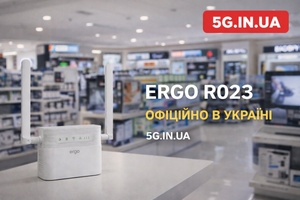
ERGO R023 is an LTE Cat.4 router without Carrier Aggregation.
Its operating logic is simple:
-
One stable LTE channel
-
Up to 150/50 Mbps theoretical speed
-
Support for external antennas via 2×SMA connectors
-
Built-in battery for autonomous operation
Practical scenarios
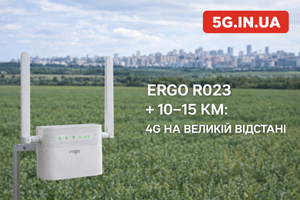
Rural area, 10–20 km from base station
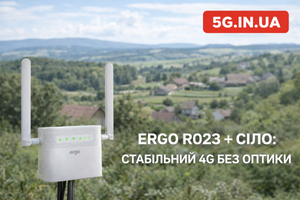
With a directional external antenna on Band 3 or Band 8, speeds of 20–70 Mbps are realistic. Carrier Aggregation is typically unnecessary in such setups.
Backup internet in an apartment
Fiber is primary. 4G is used during outages. 15–40 Mbps is usually sufficient for remote work and video calls.
Office or warehouse
Stability matters more than peak speed. Cat.4 ensures predictable operation.
When Carrier Aggregation Truly Makes a Difference
CA provides real benefit if:
-
You are in a large city
-
The base station transmits two or more LTE bands
-
Signal quality is strong on all bands
-
Network load is moderate
In such environments, Cat.6 or higher may reach 150–250 Mbps.
However, this is not a universal condition across Ukraine.
Limitations of LTE Cat.4
-
Cannot combine multiple LTE bands
-
Maximum theoretical download speed is 150 Mbps
-
Does not support advanced LTE Advanced Pro features
-
Lower peak potential in dense urban CA environments
These are technical characteristics, not flaws. For most use cases, they are sufficient.
What Matters More Than Modem Category
Signal quality
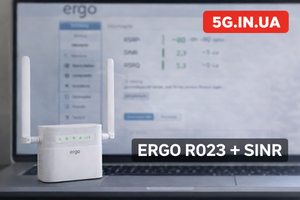
RSRP, RSRQ, and SINR are critical performance factors.
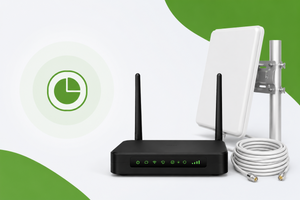
External antenna
In many cases, a properly selected antenna provides a larger speed increase than upgrading from Cat.4 to Cat.6.
Router placement
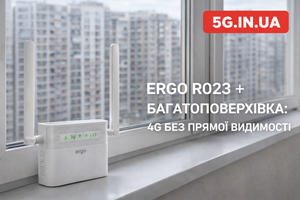
Near a window or with the antenna mounted outside.
Operator and specific base station
Network configuration and load significantly influence results.
Cat.4 vs Cat.6 Comparison (Practical Perspective)
LTE Cat.4:
-
Up to 150 Mbps
-
No Carrier Aggregation
-
Single band at a time
-
Lower device cost
LTE Cat.6:
-
Up to 300 Mbps
-
Supports Carrier Aggregation
-
Two bands simultaneously
-
Higher device cost
In weak or moderate signal conditions, the real-world difference may be minimal.
Why ERGO R023 Is a Rational Choice
ERGO R023 represents a balanced solution:
-
LTE Cat.4 (up to 150/50 Mbps)
-
2×SMA connectors for MIMO antennas
-
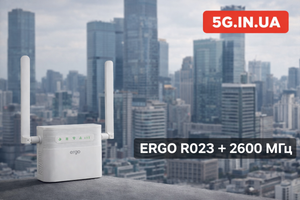
Support for major Ukrainian LTE bands (900/1800/2600 MHz)
-
Built-in battery
-
Simple web interface
It is not designed to chase maximum theoretical speeds.
It is designed to deliver stable 4G connectivity where fiber is unavailable or backup internet is required.
Common Mistakes When Choosing a 4G Router
-
Focusing only on maximum theoretical speed
-
Ignoring signal quality
-
Not using an external antenna where needed
-
Expecting 300 Mbps in weak coverage areas
Conclusion
LTE Cat.4 without Carrier Aggregation is not a limitation for most users. It is a technically clear and stable 4G architecture.
If you need:
-
Internet in a private house
-
Connectivity in a rural area
-
Backup internet
-
Stable office access
Cat.4 is sufficient.
ERGO R023 is an example of this approach: no unnecessary features, but a well-balanced architecture suited to real Ukrainian network conditions.
Detailed specifications, compatible antennas, and practical setup recommendations are available at 5G.IN.UA.
FAQ
Will LTE Cat.4 be slow in 2026?
No. For most tasks (remote work, video streaming, cloud services), 20–80 Mbps is sufficient.
Can speed be improved without Carrier Aggregation?
Yes. By improving signal quality and using a proper external antenna.
Does ERGO R023 support external antennas?
Yes, via 2×SMA connectors (MIMO 2×2).
Is Cat.4 suitable for rural areas?
Yes, especially where base stations operate on a single LTE band.
Is it worth paying extra for Cat.6?
Only if Carrier Aggregation is truly active and effective in your location.
Does the operator matter?
Yes. Speed depends on the specific base station and its load.
Is Cat.4 enough for backup internet?
Yes. It is one of the most rational and cost-effective solutions.