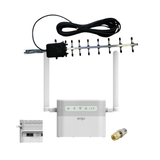
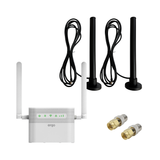
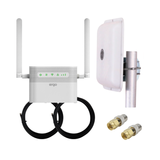
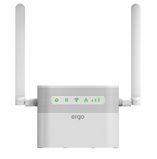
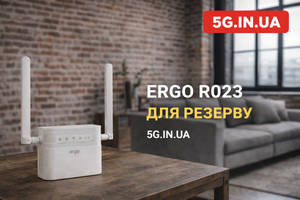
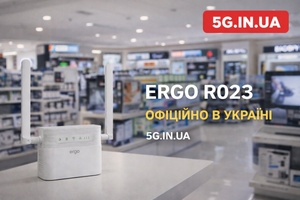
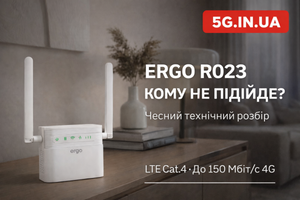
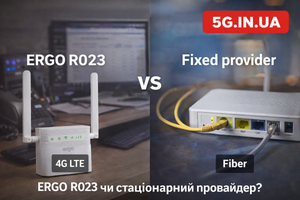
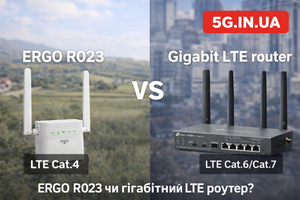
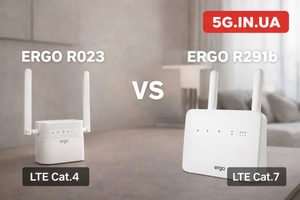
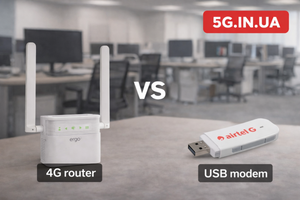
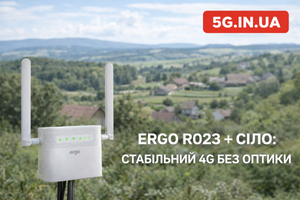
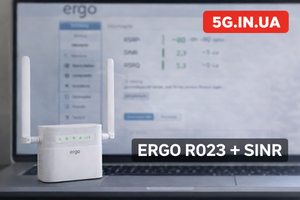
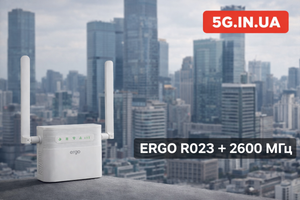
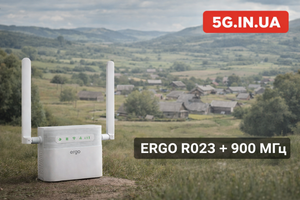
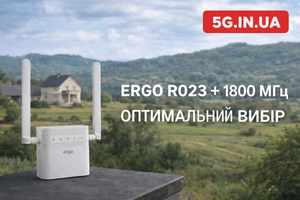
ERGO R023 is a 4G LTE Cat.4 router with a theoretical maximum speed of up to 150 Mbps download and 50 Mbps upload. LTE Cat.4 means the device operates on a single frequency band at a time without carrier aggregation (CA), supports 2×2 MIMO, and delivers stable performance within standard 4G networks (900/1800/2600 MHz). In real-world conditions, this typically results in 20–60 Mbps with a good signal and predictable behavior without extreme speed fluctuations. ERGO R023 is suitable for homes, rural areas, summer houses, or as a backup internet solution. It is not a gigabit or Cat.6/12 device, but within its category it provides technically justified stability.
What LTE Cat.4 Means in Simple Terms
LTE has categories (Cat.3, Cat.4, Cat.6, Cat.12, etc.).
The category defines:
-
maximum speed;
-
support for carrier aggregation;
-
modulation capabilities;
-
number of antenna streams.
ERGO R023 is LTE Cat.4.
This means:
-
up to 150 Mbps downlink;
-
up to 50 Mbps uplink;
-
one frequency band at a time;
-
2×2 MIMO support.
The key point: Cat.4 does not support Carrier Aggregation.
What the Lack of Carrier Aggregation Means
One Band Instead of Two
Modern base stations may transmit simultaneously on multiple bands:
-
900 MHz (Band 8)
-
1800 MHz (Band 3)
-
2600 MHz (Band 7)
Cat.6+ routers can combine two bands into a single logical data stream.
ERGO R023 cannot.
Practical Example
Base station capacity:
-
1800 MHz → 40 Mbps
-
2600 MHz → 60 Mbps
A Cat.6 device could reach 80–100+ Mbps.
ERGO R023 will select only one band.
Result: 40 or 60 Mbps.
Why 150 Mbps Is a Theoretical Maximum
150 Mbps is achievable only under near-ideal conditions:
-
RSRP ≈ -75…-85 dBm
-
SINR 18–25 dB
-
low base station load
In reality:
-
urban areas — 20–70 Mbps
-
rural areas — 15–50 Mbps
-
edge of coverage — 5–20 Mbps
This is not a flaw of ERGO R023 — it is a physical limit of LTE Cat.4.
MIMO 2×2: What It Actually Does
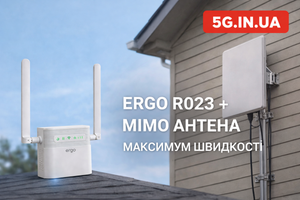
ERGO R023 supports 2×2 MIMO.
This means:
-
two independent radio streams;
-
two external antennas can be connected via SMA ports;
-
improved signal stability and throughput.
Without MIMO, throughput could be roughly halved.
Example
RSRP -95 dBm:
-
Without MIMO → 15–20 Mbps
-
With properly installed 2×2 MIMO antenna → 30–50 Mbps
Cat.4 with MIMO 2×2 provides a balance between cost and stability.
How LTE Cat.4 Performs in Real Conditions
1. Private House in a City
-
1–2 walls between router and tower
-
signal -85…-95 dBm
Result:
25–60 Mbps stable.
2. Rural Area 10–15 km from the Tower
Without external antenna:
-
5–20 Mbps
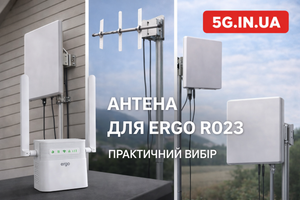
With 2×15 dBi MIMO panel antenna:
-
30–60 Mbps
In this scenario, LTE Cat.4 performs efficiently.
3. Backup Internet for Retail
When fiber fails:
-
quick switch to SIM
-
20–40 Mbps is sufficient for POS systems, CRM, payment terminals
Cat.4 is adequate for small business continuity.
Is LTE Cat.4 Enough in 2026?
Most Ukrainian LTE networks typically operate in the range of:
-
10–80 Mbps under normal load
Cat.4 fully covers this range.
Cat.6/12 becomes necessary when:
-
base stations deliver 100–200+ Mbps;
-
carrier aggregation is available;
-
peak throughput is critical.
For most households, Cat.4 is sufficient.
LTE Cat.4 Limitations in ERGO R023
-
No Carrier Aggregation
-
150 Mbps rarely achievable in practice
-
Performance strongly depends on signal quality
-
Speed decreases under heavy tower load
-
Not suitable for sustained 200–300+ Mbps requirements
These limitations must be understood before purchasing.
Who ERGO R023 with LTE Cat.4 Is Suitable For
-
Homes without fiber
-
Rural areas
-
Summer houses
-
Backup internet
-
Installations up to 20–25 km from a tower (with antenna)
Who Should Consider Cat.6+
-
Users requiring 150–250+ Mbps
-
Locations with carrier aggregation
-
High-density environments
-
Heavy traffic loads (large offices, streaming hubs, servers)
Why ERGO R023 Remains Relevant
-
Competitive price
-
Stable architecture
-
Support for 900/1800/2600 MHz
-
External antenna support
-
Built-in battery
-
Predictable performance
LTE Cat.4 is not “weak” — it is simply a different class.
FAQ — ERGO R023 and LTE Cat.4
1. Does Cat.4 mean outdated technology?
No. It remains widely deployed and supported.
2. Can it actually reach 150 Mbps?
Only under ideal signal and low-load conditions.
3. Is an external antenna necessary?
In rural or weak-signal areas — recommended.
4. What is the difference between Cat.4 and Cat.6?
Cat.6 supports carrier aggregation.
5. Is it enough for streaming and remote work?
Yes. 20–50 Mbps is sufficient for 4K streaming and online work.
6. Is it suitable for business use?
For small business — yes.
7. Does ERGO R023 support MIMO?
Yes, 2×2 via dual SMA connectors.
ERGO R023 is an LTE Cat.4 router with a theoretical maximum of 150 Mbps, no carrier aggregation, but with 2×2 MIMO and support for key Ukrainian LTE bands.
In practice, this means:
-
stable 20–60 Mbps in real conditions;
-
predictable behavior;
-
ability to improve signal via external antennas;
-
sufficient performance for home and small business.
If gigabit-class speeds are required, this is not the right device.
If stable and cost-efficient 4G connectivity is needed, ERGO R023 is technically justified.
Updated antenna-matched kits and deployment guidance are available at 5G.IN.UA, based on real coverage and installation conditions.