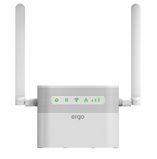
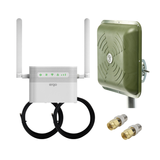
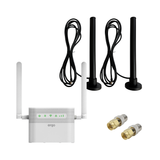
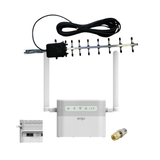
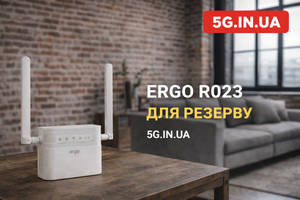
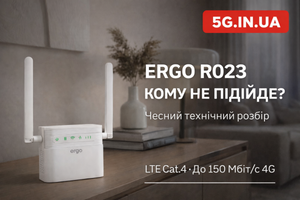
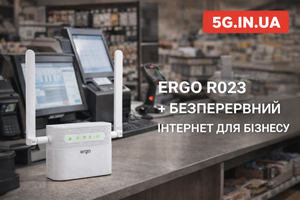
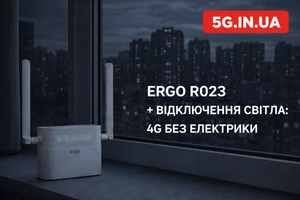
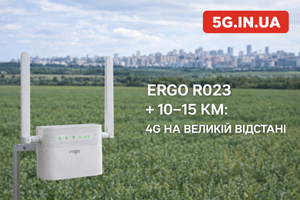
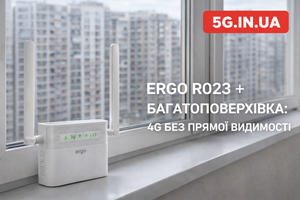
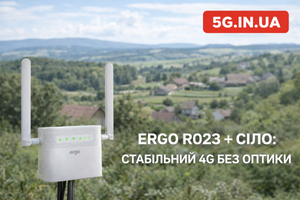
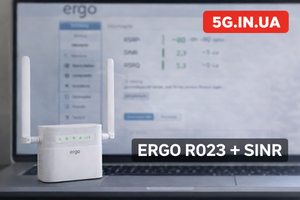
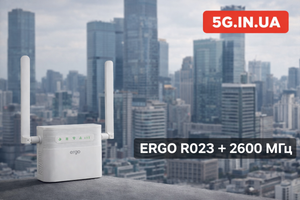
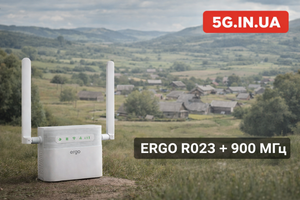
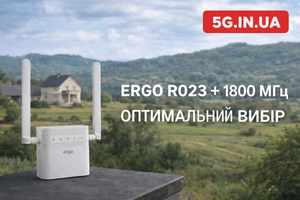
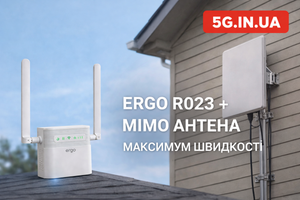
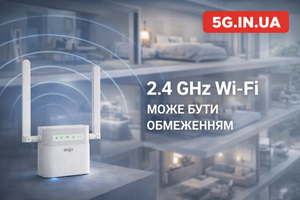
ERGO R023 is a 4G LTE Cat.4 router supporting 900/1800/2600 MHz bands with 2×2 MIMO and dual SMA connectors for external antennas. Its main limitations are the absence of carrier aggregation (CA), single-band 2.4 GHz Wi-Fi only, limited scalability for high user density, and strong dependency on LTE signal quality. It is not a high-end or gigabit-class device and is not designed for large enterprise environments. ERGO R023 is intended for stable 4G connectivity in houses, rural areas, or as a backup internet solution, not for heavy multi-band LTE aggregation or high-throughput corporate infrastructure. Understanding these limitations allows proper deployment and realistic performance expectations.
Why It Is Important to Discuss Limitations
Every technical device has boundaries.
Performance issues usually occur not because the router is “bad,” but because it is used outside its intended scenario.
ERGO R023 is a mid-range LTE Cat.4 router.
Its strength is predictable stability in typical 4G use cases.
Its weakness is the absence of advanced features found in higher LTE categories.
Let’s examine the limitations from a technical perspective.
LTE Cat.4 – The Core System Limitation
No Carrier Aggregation
ERGO R023 operates under LTE Cat.4 standard.
This means:
-
it uses one carrier frequency at a time;
-
there is no Carrier Aggregation (CA).
What This Means in Practice
Modern LTE networks can combine two or three frequency bands (for example 1800 + 2600 MHz).
Cat.6 and higher devices can merge bandwidth from multiple carriers.
ERGO R023 cannot.
Practical Example
A base station provides:
-
1800 MHz — 40 Mbps
-
2600 MHz — 60 Mbps
A Cat.6 router could combine them and achieve 80–100+ Mbps.
ERGO R023 selects only one band.
Limitation: lower peak throughput compared to higher LTE categories.
150 Mbps Maximum Speed – Theoretical Value
150 Mbps is a laboratory maximum.
To reach it, you need:
-
RSRP around -80 dBm,
-
SINR close to 20 dB,
-
minimal base station load.
In real-world deployments:
-
20–60 Mbps is typical;
-
higher speeds are possible only near the tower.
This is not a design flaw — it is a Cat.4 physical limit.
2.4 GHz Wi-Fi – A Stability-Oriented Compromise
No 5 GHz Support
ERGO R023 supports only 2.4 GHz Wi-Fi (802.11 b/g/n).
Limitations
-
lower throughput compared to dual-band routers;
-
higher interference in apartment buildings;
-
no Wi-Fi 5 or Wi-Fi 6.
When It Becomes a Problem
-
office with 30+ active clients;
-
simultaneous gaming + 4K streaming;
-
congested multi-apartment environment.
When It Is Not a Problem
-
private house;
-
rural location;
-
5–15 devices.
2.4 GHz provides better wall penetration, which is often beneficial in houses.
Performance Limitations in Weak Signal Conditions
Strong Dependence on RSRP and SINR
ERGO R023 performance is directly tied to LTE signal quality.
At RSRP below -100 dBm:
-
modulation rate drops;
-
latency increases;
-
throughput decreases significantly.
Without External Antenna
In rural areas 15–20 km from a tower:
-
speeds may fall to 5–15 Mbps.
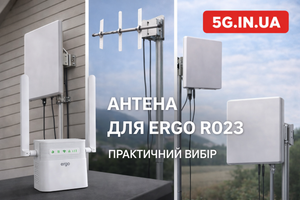
With a 2×15 dBi MIMO panel antenna:
-
30–60 Mbps becomes achievable.
The limitation is radio physics, not firmware.
Ethernet and Network Architecture Limits
Single LAN/WAN Port
ERGO R023 is not a multi-port enterprise router.
-
One Ethernet port only.
-
No built-in gigabit switch.
-
No advanced VLAN routing capabilities.
When This Is a Limitation
-
segmented networks;
-
multi-department offices;
-
server infrastructure.
For home or small retail use, this is typically sufficient.
Scalability and Load Handling
Number of Clients
ERGO R023 is realistically suited for:
-
5–15 active users.
With 30+ devices:
-
latency may increase;
-
Wi-Fi stability may degrade.
It is not built for enterprise density environments.
Battery Limitations
Autonomous, but Not Industrial-Grade
The built-in battery is an advantage, but:
-
it is not a long-duration UPS;
-
not designed for 24 hours under heavy load.
Battery runtime depends on:
-
LTE signal strength (weaker signal = higher power draw);
-
number of connected devices;
-
traffic volume.
Thermal Considerations
Like any LTE router:
-
it generates heat under load;
-
requires airflow;
-
should not be installed in closed cabinets.
Overheating can reduce long-term stability.
Full List of ERGO R023 Limitations
-
LTE Cat.4 — no carrier aggregation.
-
150 Mbps maximum — theoretical only.
-
Single-band 2.4 GHz Wi-Fi.
-
Single Ethernet port.
-
Not intended for enterprise networks.
-
Strong dependency on LTE signal quality.
-
Limited battery runtime.
-
No Wi-Fi 6 support.
Who ERGO R023 Is Not Suitable For
-
Users requiring 200–300+ Mbps speeds.
-
Environments needing LTE aggregation.
-
Large offices.
-
Complex VLAN-based infrastructures.
-
Gigabit-class networking.
Who ERGO R023 Is Suitable For Despite Limitations
-
Houses without fiber internet.
-
Rural areas.
-
Summer houses.
-
Backup connectivity for retail stores.
-
Power outage resilience.
-
Installations up to 20–25 km from a tower (with proper antenna).
In these scenarios, it performs predictably.
FAQ — ERGO R023 Limitations
1. Does ERGO R023 support carrier aggregation?
No, it is LTE Cat.4.
2. Can it reach 150 Mbps?
Only under ideal signal conditions.
3. Is it suitable for a large office?
No.
4. Is an external antenna necessary?
In weak-signal environments — yes.
5. Does it support Wi-Fi 5 or Wi-Fi 6?
No, 2.4 GHz only.
6. Is it a weak router?
No, it is properly positioned within its technical class.
7. Is it suitable for backup internet?
Yes, it is well-suited for failover use.
Conclusion
ERGO R023 has limitations typical for LTE Cat.4 devices:
-
no carrier aggregation;
-
single-band Wi-Fi;
-
limited scalability.
It is not a flagship router.
However, within its segment it provides:
-
stable LTE performance;
-
support for external MIMO antennas;
-
failover capability;
-
battery-backed operation during outages.
The key is matching the tool to the task.
If you need a predictable 4G solution for a house, rural area, or backup connection, ERGO R023 remains a technically justified option.
Updated kits with properly matched antennas and deployment consultation are available at 5G.IN.UA, where selection is based on real coverage conditions and installation specifics.