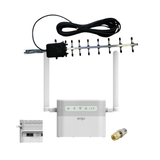
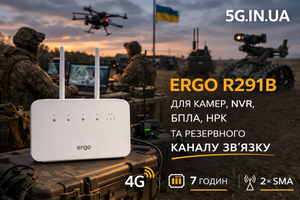
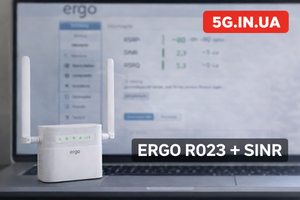
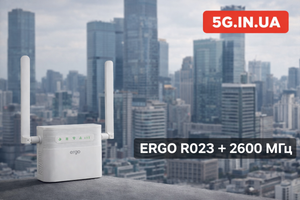
4G Internet Kit for Rural and Field Conditions: ERGO R023 + Mobile Guard LTE 1800 MHz 10 dBi Directional Antenna (10 m cable)
This kit is designed to solve a very practical and common problem: you need stable internet where there is no fiber, where wired providers are unreliable, where power outages happen, or where signal levels fluctuate depending on time of day and load. In cities, internet often “just works.” In rural areas, it has to be engineered properly. That is exactly what this kit does. It is not assembled to be the cheapest possible bundle. It is assembled to deliver predictable, stable 4G performance in real Ukrainian rural and field conditions. The system is built around the ERGO R023 router as a solid base unit, a focused 1800 MHz directional antenna to concentrate reception on a specific base station, a properly selected 10-meter cable for outdoor installation, and most importantly, the ability to upgrade to full MIMO 2×2 by adding a second identical antenna (sold separately). The philosophy is simple: this is not about chasing unrealistic speed-test numbers; it is about ensuring that your connection remains stable, consistent, and reliable throughout the day.
Why the kit focuses on 1800 MHz (LTE Band 3) and why that matters in rural areas. Outside large cities, LTE Band 3 (1800 MHz) is frequently the main capacity band used by operators. While 900 MHz offers longer range, it often provides lower capacity and lower real-world speeds. 2600 MHz can deliver high throughput but is not always available far from base stations. 1800 MHz represents a practical balance between coverage distance and usable bandwidth. In many villages and suburban locations, it is the most relevant performance band. However, at distances of several kilometers from a tower, even 1800 MHz becomes sensitive to terrain, trees, metal roofs, hills, reflections, and interference from neighboring sectors. A smartphone or indoor router with small internal antennas is rarely enough to maintain stable quality. The solution is to move the antenna outside and make it directional, so it focuses specifically on the correct base station and reduces unwanted noise.
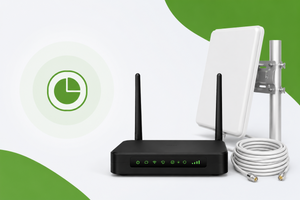
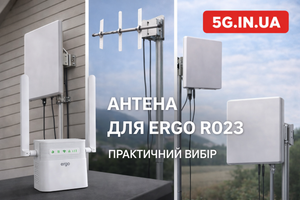
The Mobile Guard LTE 1800 MHz 10 dBi directional antenna is not a generic omnidirectional rod. It acts like a flashlight for radio signals: it concentrates reception in one direction and reduces sensitivity in others. This improves not only raw signal strength but also signal quality. In LTE, quality matters as much as level. Strong but noisy signals still perform poorly. By reducing interference from other sectors and reflections, the directional antenna improves overall channel quality and stability. In practical terms, this means fewer speed drops, fewer buffering issues when streaming, fewer connection interruptions, and improved uplink performance for video calls, surveillance cameras, cloud backups, and remote work.
Why 10 dBi is a practical and effective gain level. Higher gain does not always mean better results. Extremely narrow high-gain antennas require very precise alignment and are sensitive to movement or minor installation shifts. A 10 dBi directional antenna offers a strong and noticeable improvement while remaining relatively easy to align and stable under typical rural installation conditions. It provides real-world performance benefits without requiring complex installation procedures.
The included 10-meter 50 Ohm coaxial cable is an important part of the system design. Cable length directly affects signal loss. If it is too long, performance is reduced at higher frequencies. If it is too short, installation options become limited and the antenna cannot be placed at the optimal height. Ten meters represents a balanced and technically justified compromise. It allows proper outdoor mounting above roof level or on a façade while keeping signal losses within acceptable limits. It is preselected and fully compatible, so no additional adapters or guesswork are required.
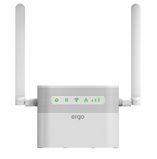
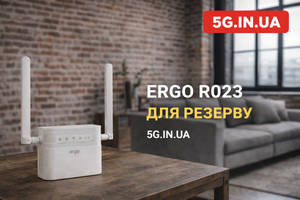
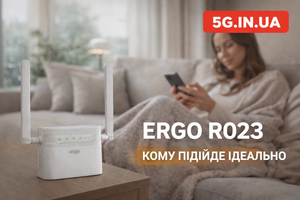
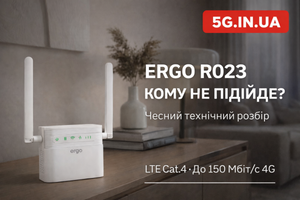
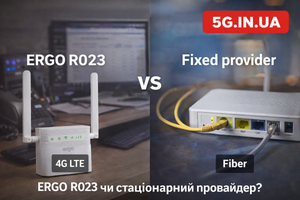
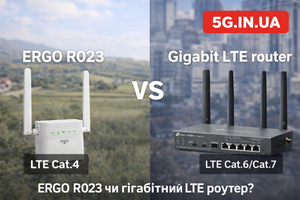
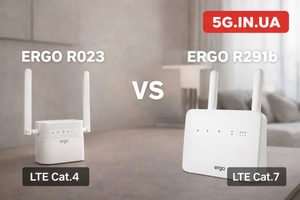
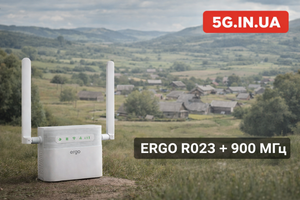
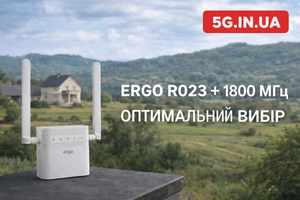
The ERGO R023 router serves as the central unit of the system. It is an LTE Cat.4 device supporting download speeds up to 150 Mbps and upload speeds up to 50 Mbps. In rural areas, actual speed depends more on network conditions than on modem category, but Cat.4 remains a stable and widely compatible platform for Ukrainian networks. The router supports LTE bands 900 / 1800 / 2600 MHz, ensuring flexibility if conditions change or if another band becomes more optimal in a given location. It provides 2.4 GHz Wi-Fi up to 300 Mbps, which in rural homes often offers better wall penetration and wider indoor coverage compared to 5 GHz. The router also includes WAN/LAN and LAN Ethernet ports, allowing direct wired connections to PCs, televisions, DVR/NVR systems, or secondary routers. It supports using wired internet as a primary connection with 4G as automatic failover, making it suitable both as a main internet source and as a backup solution.
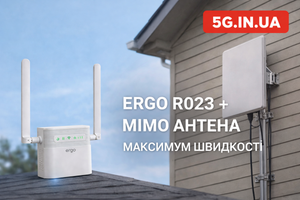
One of the most important technical advantages is the presence of two SMA Female connectors and full support for MIMO 2×2 technology. LTE networks operate using multiple parallel data streams. To fully utilize this capability, two independent antennas are required. When only one antenna is connected, the system may operate effectively in single-stream mode, which reduces maximum performance and stability in challenging conditions. By connecting a second identical directional antenna (sold separately), the system transitions to full MIMO 2×2 operation. This means two independent spatial channels are received simultaneously, improving overall robustness, uplink stability, resistance to interference, and performance under network load.
The practical benefits of upgrading to MIMO 2×2 include improved link stability, better signal-to-noise ratio behavior under fluctuating conditions, stronger and more reliable upload performance, reduced sensitivity to sector congestion during peak hours, and improved reliability for video surveillance and cloud services. In challenging terrain or at greater distances from base stations, MIMO improves not only speed but consistency. This consistency is often more valuable than peak speed in rural environments.
The integrated 4000 mAh removable battery adds another major advantage. Power outages are common in many rural and suburban areas. With this router, internet connectivity does not disappear immediately when electricity fails. Short interruptions, voltage switching, or brief outages do not disrupt communication, surveillance systems, or ongoing online work. No additional UPS is required for short-term resilience. The router continues operating on its internal battery, providing a practical and reliable layer of backup.
Installation logic is straightforward. The router remains indoors for protection and convenient access. The directional antenna is mounted outdoors at an elevated position, ideally above roof level or at the highest practical mounting point. It is then aligned toward the base station using signal quality indicators available in the router interface. Once properly aligned, the system operates as a stable and consistent rural internet solution.
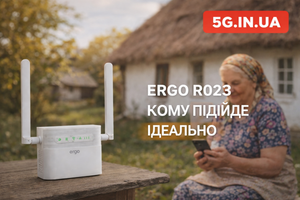
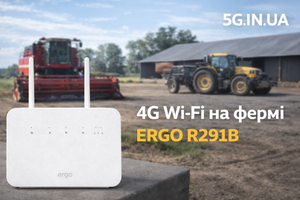
This kit is ideal for private houses in villages or suburbs, cottages, farms, field offices, construction sites, warehouses, security checkpoints, and any location without fiber connectivity but with available LTE coverage. It is also well suited for video surveillance deployments where stable uplink performance is critical.
What makes this solution high quality is the logical integration of components. The router supports relevant LTE bands and full MIMO capability. The antenna is specifically designed for 1800 MHz performance rather than generic wideband compromise. The cable length is selected for real installation scenarios. The battery ensures resilience during outages. Most importantly, the system can grow with user needs. It starts as a strong single-antenna directional solution and can be upgraded to full MIMO without replacing the router.
Choosing between one antenna and two antennas depends on site conditions. In moderate signal areas with partial visibility to the tower, a single directional antenna may provide sufficient stability. In more challenging environments—greater than 5 km distance, difficult terrain, heavy foliage, or mission-critical surveillance—adding a second antenna for full MIMO provides measurable improvement in consistency and resilience.
In summary, this 4G internet kit delivers what rural users truly need: stable LTE reception, indoor Wi-Fi distribution, wired connectivity options, power backup resilience, and scalable MIMO capability. It is not an experimental solution. It is a technically sound and practical system designed for real rural and field conditions where reliability matters more than marketing claims.