Which 4G Router to Choose: City or Rural Area
A practical comparison of ERGO R291b and ERGO R023 without complex diagnostics or technical analysis
Most users do not check whether carrier aggregation (CA) is active on their base station, do not analyze sector load, and do not verify which LTE bands are actually available. People want a simple solution that works reliably without detailed configuration. Therefore, the most practical approach is to choose based on location type — city or rural area.
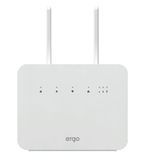
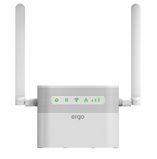
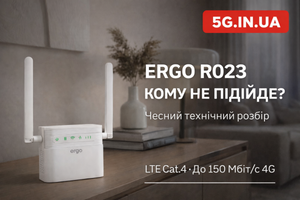
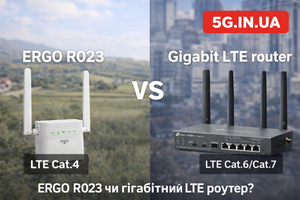
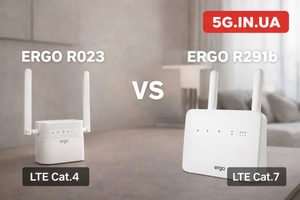
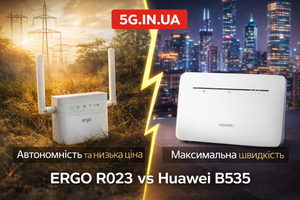
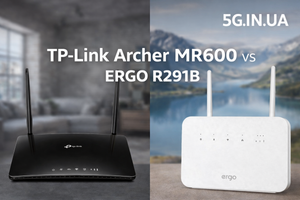
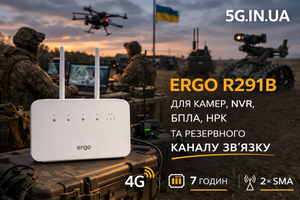
The core difference between these two routers is the LTE category and network capability. ERGO R023 is LTE Cat.4 with theoretical speeds up to 150 Mbps download and 50 Mbps upload. It operates on a single LTE carrier at a time. Wi-Fi is limited to 2.4 GHz, and Ethernet ports support up to 100 Mbps. ERGO R291b is LTE Cat.7 with theoretical speeds up to 300 Mbps download and 100 Mbps upload. It supports 2-carrier aggregation (2CA), dual-band Wi-Fi (2.4 GHz and 5 GHz), and Gigabit Ethernet ports. Both models include 2×SMA connectors for external MIMO antennas and a 4000 mAh battery.
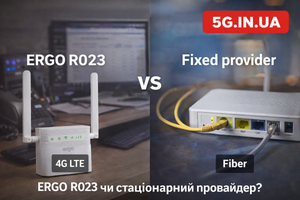
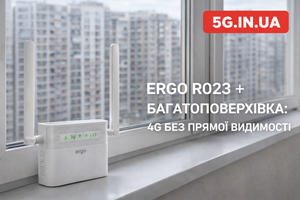
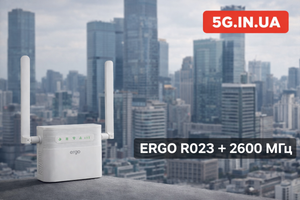
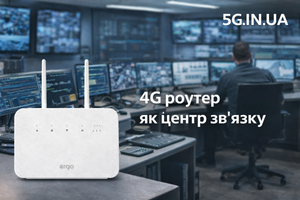
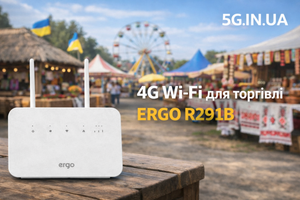
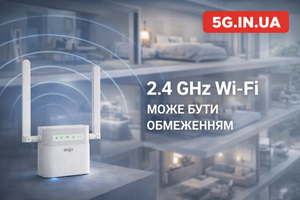
Now the logic for city use. In urban areas, operators typically deploy multiple LTE bands simultaneously, such as 1800 MHz, 2600 MHz, and often 2100 MHz. These networks frequently support carrier aggregation. This means the router can receive data from two frequency bands at the same time, resulting in higher real-world speeds. ERGO R291b supports this feature, while ERGO R023 does not. If signal quality is good and aggregation is available, R291b often delivers 120–200 Mbps in real conditions, while R023 usually operates in the 60–100 Mbps range under similar circumstances. Another important factor in cities is Wi-Fi congestion. The 2.4 GHz band is heavily crowded in apartment buildings due to neighboring networks. R291b includes 5 GHz Wi-Fi, where interference is significantly lower and throughput is higher. R023 operates only on 2.4 GHz, so wireless performance may be reduced in dense residential environments. There is also a difference in wired connectivity. If the LTE network provides 150–200 Mbps, the Gigabit ports of R291b allow that speed to pass through to connected devices without restriction at the Ethernet level. R023 Ethernet ports are limited to 100 Mbps, so wired speeds cannot exceed that value even if the mobile network supports higher throughput. For apartments, offices, multiple devices, video surveillance, or heavy cloud usage in cities, R291b is the more suitable option.
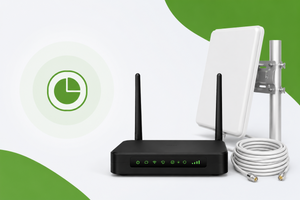
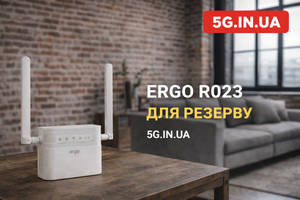
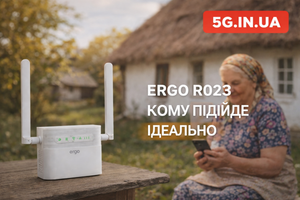
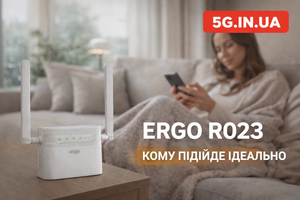
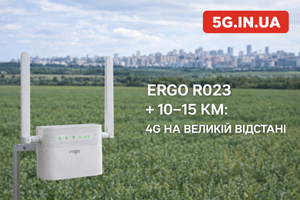
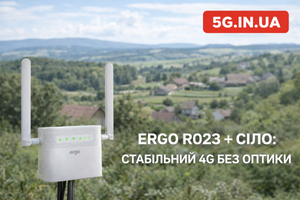
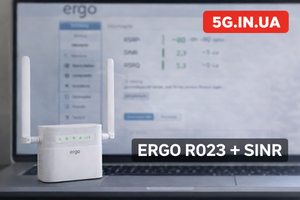
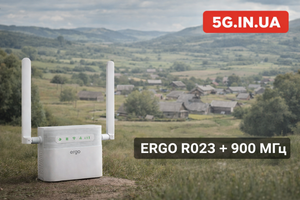
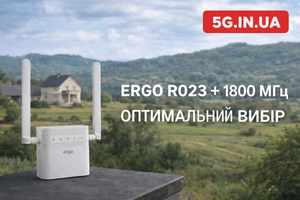
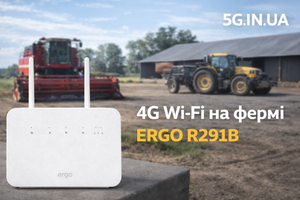
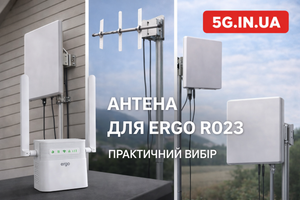
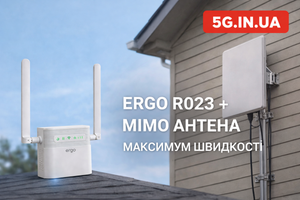
Now the rural scenario. In many rural areas, only one LTE band is active, often 900 MHz or a single 1800 MHz carrier. In such cases, carrier aggregation is unavailable or inactive at that specific location. Even if a directional external antenna is installed and signal quality is good, if only one LTE carrier is present, Cat.7 provides no meaningful speed advantage. R291b will perform similarly to a Cat.4 router in LTE terms. Therefore, in rural environments where the priority is stability rather than maximum throughput, ERGO R023 is sufficient. It supports 2×2 MIMO, allows connection of a directional antenna, and operates reliably on a single carrier while delivering speeds adequate for streaming, work applications, POS systems, cameras, and several connected users. Rural sectors typically have fewer subscribers, so Cat.4 often delivers stable performance without significant congestion issues. For common use cases — 5–10 devices, video streaming, document work, and standard online services — R023 meets requirements effectively.
There are exceptions. If a rural location is close to a city and two LTE bands are actually available simultaneously, R291b may provide a noticeable advantage even outside urban areas. The same applies if high throughput or many connected devices are required. However, if you prefer not to analyze bands or check CA status, a simple rule works in most cases: city — choose R291b; rural area — choose R023.
Final conclusion without technical complexity: cities usually have multiple active bands, higher network load, and heavier Wi-Fi congestion, making a Cat.7 router with dual-band Wi-Fi and Gigabit ports the logical choice. Rural areas often operate on a single LTE band with lower demand, where Cat.4 is fully adequate, especially when paired with a directional external antenna. If you want performance headroom and future flexibility, choose R291b. If you need stable connectivity without paying for unused capacity, choose R023.