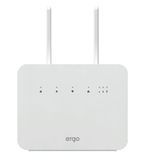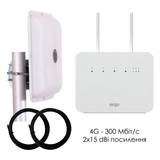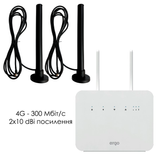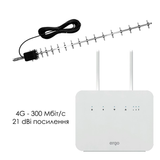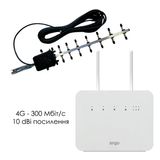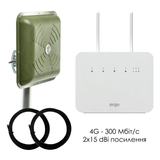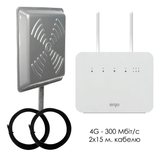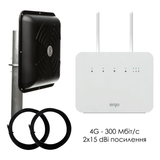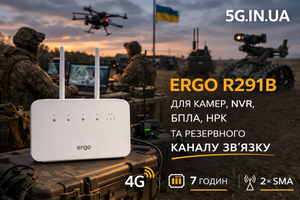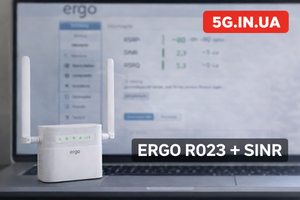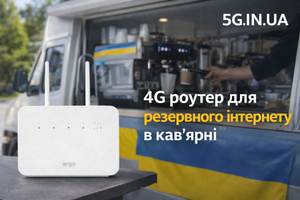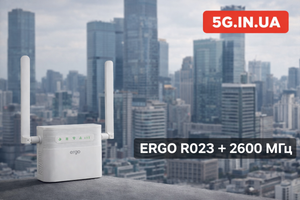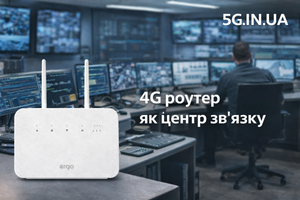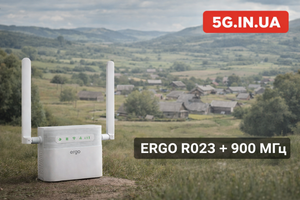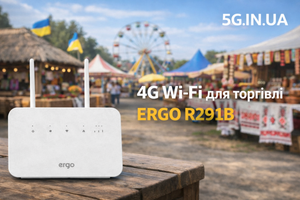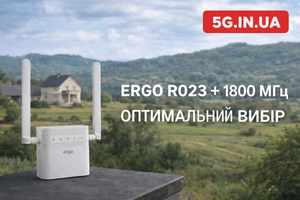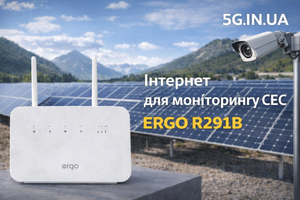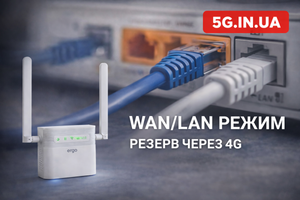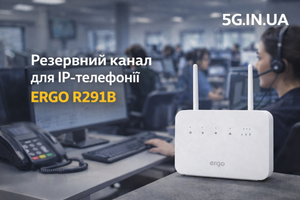
If you need a short conclusion without marketing noise, it is simple: TP-Link Archer MR600 and ERGO R291B belong to the same class of 4G Wi-Fi routers for home, office, cottage, surveillance cameras, and backup internet, but their logic is different. MR600 focuses on the brand, the TP-Link ecosystem, and a typical stationary use case. ERGO R291B focuses on practical use: LTE Cat.7, AC1200, 1× WAN/LAN + 3× Gigabit LAN, 2× SMA for an external MIMO antenna, a built-in 4000 mAh battery, and autonomous operation for up to 7 hours. If you simply need a home 4G router from a well-known brand, MR600 looks understandable. If you need a tool for a real-world scenario with power outages, weak coverage, an external antenna, and the need to stay online without a separate UPS, ERGO R291B looks more practical and rational.
Why Archer MR600 and ERGO R291B are compared at all
These models are often compared for a reason. Both routers are not pocket MiFi devices, but full-fledged 4G CPE units for stationary or semi-stationary use. They work with a SIM card, distribute internet over Wi-Fi, have Ethernet ports, support external LTE antennas, and are suitable for scenarios where wired internet is unavailable or unstable. That is why people compare them not as “a more expensive and a cheaper router,” but as two ways to solve the same practical task.
On paper, they look similar: both support AC1200 Wi-Fi, both have Gigabit Ethernet ports, and both can serve as a primary or backup internet channel. But after the first careful comparison, the difference becomes substantial: ERGO R291B has a built-in 4000 mAh battery and claimed autonomous operation of up to 7 hours, while Archer MR600 works like a classic stationary router without an internal battery.
The main difference: stationary comfort versus practical autonomy
TP-Link Archer MR600 is a classic home model that fits well into a standard scenario: an apartment, a house, an office, a SIM card, power from the mains, several devices over Wi-Fi, maybe a computer, TV, or camera connected via LAN. TP-Link additionally promotes typical brand features such as the Tether app, OneMesh, support for a large number of clients, and the overall ecosystem of the brand. For some users, this is a plus, but only when those functions are actually used.
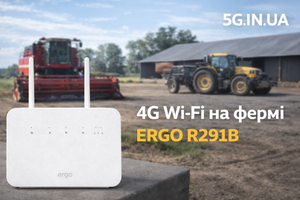
ERGO R291B initially looks like a router for a tougher real-world scenario. It also has AC1200, Gigabit ports, and 2× SMA, but the key focus is not on “smart extras,” but on the ability to keep working where there are power interruptions, unstable coverage, or the need for mobility within one site. That is why the built-in battery here is not a decorative bonus, but one of the key advantages. In practical tests and store materials, ERGO R291B is described as providing real autonomous operation of 6–7 hours, and in standard consumer wording that means operation for up to 7 hours.
LTE comparison: Cat.6 versus Cat.7
In terms of the LTE modem, ERGO R291B looks stronger. Its product page lists LTE Cat.7, while TP-Link Archer MR600 is positioned as 4G+ Cat.6. In both cases, these are routers with carrier aggregation, but Cat.7 formally has a higher uplink and a higher modem class. In practice, this does not mean that ERGO will always show higher speed everywhere, because everything depends on the base station, network load, operator frequencies, and signal quality. But if you look specifically at the LTE modem class, ERGO R291B stands above Archer MR600.
This matters not only as a nice number in the specifications. In real life, the difference between Cat.6 and Cat.7 appears when the router is not just used to “check messages and open websites,” but handles backup internet for an office, video surveillance, remote access to an NVR, large file uploads, or simultaneous work by several users. In such conditions, headroom in the modem does not create miracles, but it gives a better chance that the router itself will not become the bottleneck.
Wi-Fi: similar in numbers, different in logic
There is no real sensation here. Both MR600 and ERGO R291B work in two bands — 2.4 GHz and 5 GHz, and their Wi-Fi class is AC1200. For TP-Link, these are the standard claimed speeds of up to 300 Mbps on 2.4 GHz and up to 867 Mbps on 5 GHz. ERGO R291B is also listed as Wi-Fi AC1200, which means the same general class on the wireless side.
The difference lies elsewhere. TP-Link officially emphasizes support for up to 64 Wi-Fi devices, MU-MIMO, and additional ecosystem features. For ERGO R291B, the specifications mention up to 32 users. In an ordinary home or small business use case, this difference is almost never decisive. In an apartment, house, small office, cottage, or field site, what matters much more is not whether the router can “see” 64 clients on paper, but whether it holds the internet connection steadily, does not lose LTE, and does not die together with the power supply. In exactly this grounded scenario, ERGO R291B looks more meaningful.
Ports, antennas, SIM: this is where real practicality starts
On the wired side, the models are very close. ERGO R291B has 1× WAN/LAN + 3× LAN 10/100/1000, which means four Gigabit ports in total. Archer MR600 also belongs to the segment with a Gigabit WAN/LAN port and three LAN ports, so both are suitable for cameras, TVs, computers, cash registers, NVRs, or access points.
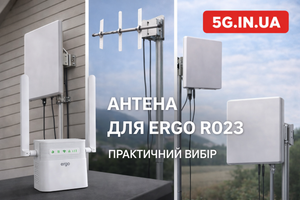
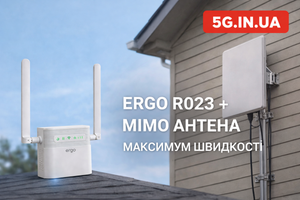
For external LTE antennas, the difference is not in quantity but in how it plays out in real tasks. ERGO R291B has 2× SMA (MIMO 2×2), which is directly suitable for connecting external 4G MIMO antennas. MR600 also has two removable external LTE antennas, so both routers can technically be used in weak coverage areas with an external antenna. But in the Ukrainian use case, where an external antenna is often not an “improvement” but a mandatory part of the system at distances of 10–20 km from a base station or in difficult terrain, the combination of Cat.7 + 2× SMA + autonomous operation for up to 7 hours makes ERGO look stronger.
One more small practical point: ERGO R291B uses a mini-SIM, while MR600 uses a micro-SIM. This is neither an advantage nor a disadvantage by itself, but it matters when replacing equipment or moving a SIM card from another device.
Where TP-Link Archer MR600 really looks convincing
It would be inaccurate to say that MR600 loses across the board. It has clear strengths. First, there is the TP-Link brand, which for many people lowers the psychological barrier to purchase by itself. Second, there is the typical TP-Link ecosystem: an official app, documentation, a user guide, a familiar interface, and a predictable setup logic. For a user who simply wants to “buy a TP-Link and not think about it,” that really is an argument.
In addition, MR600 fits well into a standard home scenario where autonomy is not an issue. If an apartment has stable electricity or already has a separate UPS, if the router stays in one place for years, if an external antenna is not needed or the signal is already good, then MR600 does its job without surprises. For some buyers, that is enough.
Where ERGO R291B looks stronger and why that matters
The strength of ERGO R291B is not that it has “more features,” but that its strong points align better with real Ukrainian tasks. The first is autonomous operation of up to 7 hours from the built-in 4000 mAh battery. That means when power disappears, the router does not die together with the socket and does not require a separate UPS in a basic scenario. For an apartment, private house, cottage, small office, guard post, surveillance point, or backup internet line, this is not an “extra option,” but a concrete difference between “internet works” and “internet is gone.”
The second is a stronger LTE modem by class. For the user, this will not necessarily show up as a permanently higher speed test result, but from a normal engineering perspective, having modem headroom is better than not having it. The third is 2× SMA and a proper external MIMO antenna scenario, which is especially important for suburbs, cottages, villages, warehouses, workshops, and all places where 4G works poorly or unstably without an external antenna.
The fourth is the logic of a universal device. ERGO R291B can be installed as a stationary router in an apartment, moved to a cottage, used as a backup for cameras or an NVR, temporarily placed in an office when the provider fails, and, if necessary, powered through an appropriate power solution. That is why it looks not like “just another router with a SIM card,” but like a more flexible tool.
Honest scenarios where Archer MR600 may be a good choice
MR600 is perfectly suitable if your scenario is simple: good 4G signal, constant mains power, no need for autonomous operation, no task of surviving power outages without extra equipment, and the TP-Link brand matters more to you than a battery and Cat.7. In such a situation, it is not a bad choice.
It also makes sense if you already have a TP-Link ecosystem at home and you really need compatible features from this brand. But the key word here is really. If a person does not use a mesh system, does not manage the network through an app, and does not have dozens of simultaneous clients, then part of MR600’s advantages remain on paper rather than in real life.
Honest scenarios where ERGO R291B may also not fit
ERGO R291B is not a magical solution for every task. If you have very good coverage, stable power, no need for autonomy, and your main selection criterion is only a large global brand with an ecosystem, then part of its strong points may simply not matter to you.
It also does not cancel out the physics of radio communication. If the location has difficult coverage, is far from the base station, or has serious obstacles, a good router alone will not solve the problem without the right external MIMO antenna, cable, and proper installation. In such conditions, the real question is not “which router looks better,” but how correctly the entire communication system is built. And here R291B is strong not because of miracles, but because it integrates well into such a system.
What is better for a real user in Ukraine
If you remove the marketing layers, the comparison looks like this. TP-Link Archer MR600 is an understandable branded 4G router for a stationary scenario. ERGO R291B is a 4G router that better matches a scenario where up to 7 hours of autonomous operation, external antenna support, backup internet, portable use across different sites, and a stronger LTE modem class matter. For the Ukrainian market, these are often not minor details, but the main selection criteria.
That is why in scenarios such as “the power is out,” “the wired provider is down,” “4G has to be pulled in with an external antenna,” “internet is needed for cameras or an NVR,” or “the router needs to be moved quickly from an apartment to a cottage or an office,” ERGO R291B looks like the more relevant choice than Archer MR600. Not because of loud promises, but because its strong points match the real task.
Conclusion
TP-Link Archer MR600 and ERGO R291B are close in class, but not identical in meaning. MR600 is more about a familiar branded home LTE router. ERGO R291B is more about a practical tool for real life: LTE Cat.7, Wi-Fi AC1200, 2× SMA, Gigabit ports, WAN/LAN, a built-in 4000 mAh battery, and autonomous operation for up to 7 hours. If you need not just “a router with a SIM,” but a solution for backup internet, power outages, weak coverage, or an external antenna, ERGO R291B looks stronger and more rational. That is exactly the scenario in which it makes sense to consider it first on 5G.IN.UA.
FAQ
What is the strongest difference between ERGO R291B and TP-Link Archer MR600?
The most noticeable difference is the built-in 4000 mAh battery in ERGO R291B with autonomous operation for up to 7 hours, as well as the higher LTE modem class: Cat.7 versus Cat.6 in MR600.
Can an external 4G antenna be connected to both models?
Yes. ERGO R291B has 2× SMA, and MR600 also has two external LTE antennas and supports LTE operation with antennas.
Which router is better for power outages?
For power outages, ERGO R291B is more practical because it can operate autonomously for up to 7 hours without a separate UPS. MR600 does not have that built-in autonomy.
Which router is better for an apartment or house without special requirements?
If you simply need a stationary 4G router from a well-known brand and autonomy does not matter, TP-Link Archer MR600 is a reasonable option. If you want headroom for power outages and a more flexible practical scenario, ERGO R291B looks more interesting.
Will ERGO R291B always be faster than MR600?
Not always. Real speed depends on the operator, base station load, frequencies, signal quality, and antenna. But in terms of modem class, ERGO R291B is stronger, so it has better LTE headroom.
Which router is better for surveillance cameras or an NVR?
For this kind of scenario, ERGO R291B looks more practical, especially where backup connectivity, autonomy, and external antenna support matter. For surveillance, that is often more important than additional home ecosystem features.
Is ERGO R291B suitable for a cottage, suburb, or village?
Yes, especially if the 4G signal is weak and an external MIMO antenna is planned. It fits well into remote-site scenarios where signal quality and backup operation matter.