New for 2026: ERGO R023 4G Wi-Fi Router — Real-World Range, Technical Limits, and Practical Performance in Ukraine
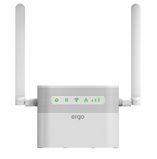
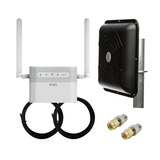
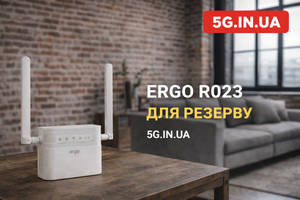
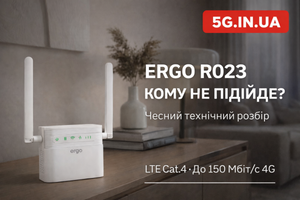
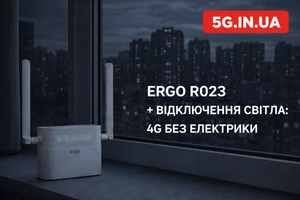
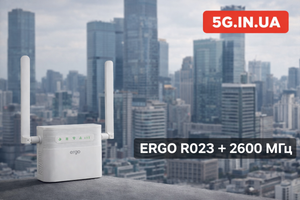
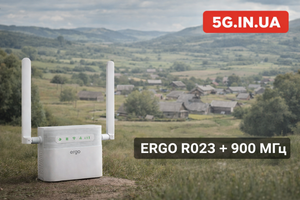
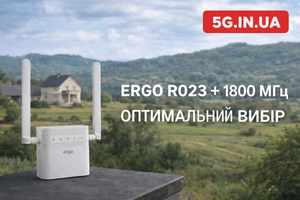
ERGO R023 is a 4G LTE Wi-Fi router (LTE Cat.4) equipped with two SMA Female connectors for external antennas, MIMO 2×2 support, micro-SIM slot, LTE-FDD bands 900 / 1800 / 2600 MHz, theoretical speeds up to 150 Mbps downlink and 50 Mbps uplink, and a built-in battery for backup operation during power outages. In 2026, it represents a balanced solution for private houses, rural areas, backup connectivity, and locations without fiber infrastructure. However, its real performance depends on radio physics and antenna configuration rather than marketing specifications.
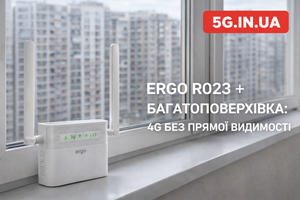
The concept of “router range” is technically incorrect. Range is determined by base station power and height, operating frequency, terrain profile, line of sight conditions, interference level, and signal metrics such as RSRP, RSRQ, and SINR. Without an external antenna, stable operation in urban areas is typically achievable within 3–5 km from the base station. At 5–10 km, throughput degradation becomes noticeable due to reduced SINR. Beyond 10 km, stability becomes highly dependent on building structure and environmental factors. In private houses, modern construction materials such as metal roofing, foil insulation, reinforced concrete, and energy-efficient windows can attenuate LTE signal by 10–25 dB, significantly lowering RSRP and SINR.
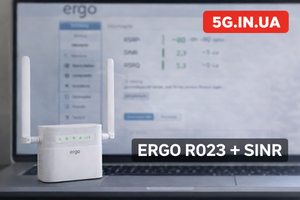
The primary factor affecting real speed is signal quality rather than modem category. When RSRP is around −110 dBm and SINR falls below 5 dB, the network shifts to lower modulation schemes such as QPSK, limiting throughput regardless of the tariff plan. If an external MIMO antenna improves SINR to 15–20 dB and raises RSRP to −85…−95 dBm, the network can operate using 64QAM, resulting in a 3–5× increase in real speed. In practical deployments, improving SINR often provides greater performance gains than upgrading from Cat.4 to Cat.9 without antenna optimization.
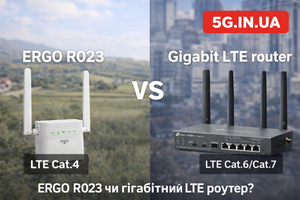
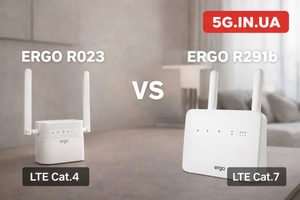
ERGO R023 operates under LTE Category 4, meaning it does not support Carrier Aggregation (CA) and utilizes a single LTE carrier at a time. The theoretical maximum of 150 Mbps is achievable only under optimal SINR and wide channel bandwidth conditions. In Ukrainian networks, real-world speeds typically range from 20–80 Mbps in cities, 10–40 Mbps in suburban or private housing areas, and 5–30 Mbps in rural environments. Therefore, Cat.4 is rarely the limiting factor. Bottlenecks are usually caused by sector congestion or poor signal conditions. The router supports MIMO 2×2, matching the configuration of most regional LTE base stations. It does not support 4×4 MIMO or 5G and is not designed for ultra-high-throughput or next-generation 5G deployments.
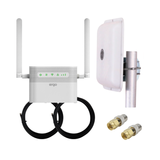
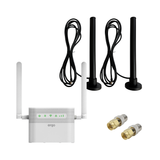
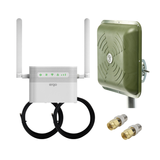
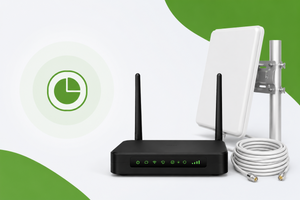
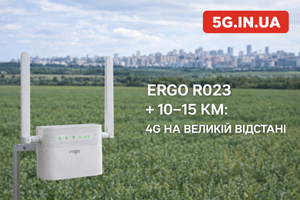
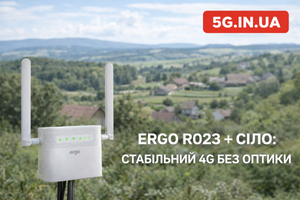
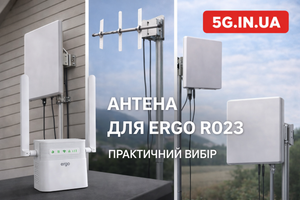
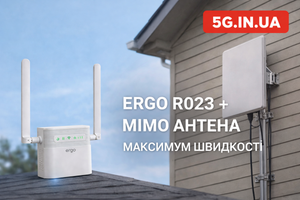
For private houses, the most effective configuration involves a directional MIMO 2×15 dBi outdoor antenna properly aligned toward the base station. This setup enables stable operation at distances of 10–20 km and, under line-of-sight conditions, potentially 20–25 km. In urban scenarios or mobile applications, two 10 dBi magnetic antennas are often sufficient to overcome structural shielding effects without complex installation. It is important to note that signal repeaters are prohibited in Ukraine; the only legal method of improving LTE performance is through direct external antenna connection to the router.
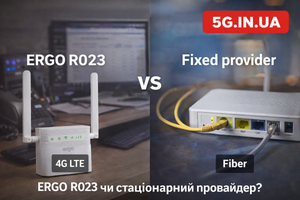
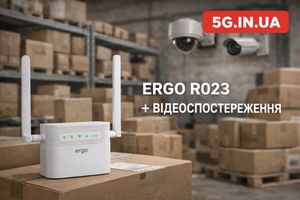
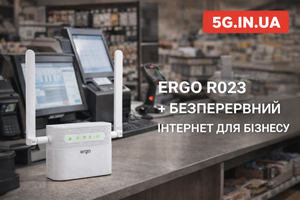
ERGO R023 is suitable for private houses without fiber, backup internet in apartments or offices, CCTV systems, alarm systems, POS terminals, warehouses, retail points, and vehicle connectivity in areas with stable LTE coverage. It is not recommended for environments with stable gigabit fiber connections, areas without LTE coverage, or scenarios requiring 5G connectivity.
The main conclusion is that ERGO R023’s effectiveness is defined not by its 150 Mbps theoretical rating but by signal quality, proper antenna selection, and interference conditions. In most real Ukrainian scenarios, optimizing SINR through external MIMO antennas delivers significantly greater improvements in stability and throughput than upgrading to higher LTE categories without signal enhancement.
FAQ
Does ERGO R023 deliver 100 Mbps? Yes, if SINR is 10–20 dB, the sector is not congested, and the device operates on 1800 or 2600 MHz with adequate channel bandwidth.
Is LTE Cat.4 sufficient in 2026? In most Ukrainian regions, yes, since real network speeds typically remain below 80 Mbps.
What matters more: modem category or antenna? Antenna quality and signal strength have greater impact than upgrading from Cat.4 to Cat.9 without improving reception.
What is the real working range? With a 2×15 dBi MIMO antenna, 10–20 km is realistic; under line-of-sight conditions, greater distances are possible. Without an external antenna, stability decreases significantly beyond 10 km.
Is it suitable for rural areas? Yes, provided LTE coverage exists and an appropriate external antenna is installed.