When connectivity is needed not “later,” but right now, the key factor is not the brand or some abstract maximum speed, but the system’s ability to deploy quickly, work reliably, and avoid requiring complex infrastructure. For military, humanitarian, and field headquarters tasks, this is especially critical: the site may be temporary, there may be no wired internet at all, and connectivity is needed for coordination, messengers, browser access, documents, mapping, CRM, online spreadsheets, video surveillance, or a basic office workflow. In this scenario, a 4G router with a SIM card is often the most rational format for deployment.
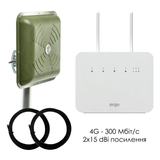
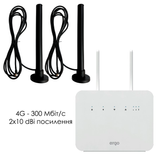
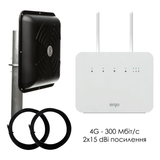
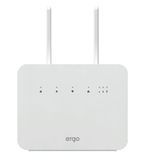
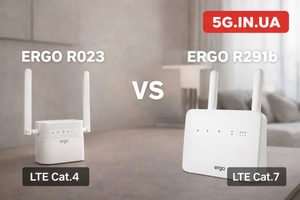
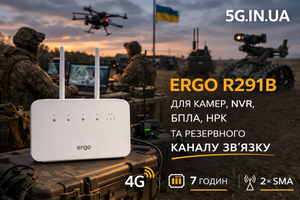
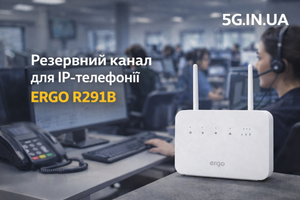
ERGO R291B is well suited to exactly these tasks. The model supports 4G LTE Cat.7, 2CA aggregation, dual-band AC1200 Wi-Fi, has 1× WAN/LAN and 3× LAN 10/100/1000, 2× SMA for external LTE antennas, supports up to 32 users, and includes a 4000 mAh battery. Its built-in battery is enough for autonomous operation for up to 7 hours, which matters in locations where power interruptions may occur alongside connectivity problems.
Why Fast Deployment Matters More Than “Ideal” Infrastructure in Field and Mobile Tasks
In a fixed office, you can wait a week for a provider, a separate installation, and approvals. In a mobile headquarters, humanitarian point, temporary coordination center, or field office, that logic often does not work. Here, the value lies not in the theoretically best setup, but in the one that provides connectivity today.
Field tasks usually share several common characteristics.
The Location Changes or Is Temporary From the Start
The premises may be rented, mobile, temporarily arranged, or used only for a specific period. In that case, permanent wired internet is often either inappropriate or physically unavailable.
The Basic Work Layer Must Be Connected Quickly
This is not about entertainment internet. It is about practical things: laptops, payment terminals, cameras, work smartphones, document printing, messengers, browsers, spreadsheets, email, mapping services, and file exchange.
The Problem Is Not Only Connectivity, but Also Power
Field locations often have unstable electrical supply or rely on backup power. If internet depends on an external power supply with no reserve autonomy, the link may fail at the exact moment it is needed most.
That is why a 4G router with proper network architecture and a built-in battery looks not like a compromise, but like a working tool.
Where This Type of Internet Is Actually Appropriate
This is not only about “military use” in a narrow sense. The practical scope is much broader.
Temporary Headquarters or Coordination Point
When you need to quickly establish a workplace for several people, bring online laptops, messengers, spreadsheets, documents, printing, browsers, and basic coordination, a 4G router provides connectivity without waiting for a provider.
Humanitarian Point, Warehouse, or Field Office
Humanitarian tasks often depend on records, forms, lists, photo documentation, communication with suppliers, logistics, and internal chats. In such conditions, what is needed is not “home Wi-Fi,” but a mobile communication node that can be quickly deployed and just as quickly relocated.
Mobile Working Point in Field Conditions
When a site launches in a new location or moves, the most important characteristic is not being tied to a specific cable. In that sense, 4G solves the task much more naturally than wired internet.
Backup for an Existing Point
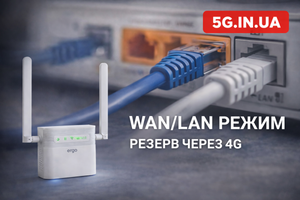
Even where a main internet channel already exists, a dedicated 4G router can work as an independent backup channel. If the wired provider fails, operations do not stop completely.
Why 4G Is Often the Most Rational Solution
The important thing here is not marketing, but task logic.
4G Does Not Require Complex Installation
SIM card, router, the correct installation point, and, if necessary, an external antenna — and the basic working channel is ready. In the context of rapid deployment, this is a major advantage.
4G Does Not Tie You to One Address
If the point changes, the router moves with it. This is especially important for mobile headquarters, volunteer, and field scenarios.
4G Is Enough for Most Work Tasks
For browser access, messengers, documents, email, CRM, spreadsheets, web dashboards, basic video surveillance, and coordination work, 4G is sufficient in most cases. What is needed is not “record speed,” but predictable operability.
4G Can Be Strengthened Where the Site Has Difficult Reception
Metal structures, temporary buildings, dense urban development, lower floors, or rooms deep inside a structure all make reception harder. That is exactly why external LTE antenna support often becomes decisive.
Why ERGO R291B Fits Fast Deployment Specifically
ERGO R291B has a feature set that aligns well with the logic of a mobile or temporary communications point.
LTE Cat.7 and 2CA Provide Channel Headroom
The model supports LTE Cat.7 and 2CA aggregation. In practice, this does not mean “magical internet,” but a proper capacity reserve and more mature behavior than basic LTE solutions. For field and headquarters tasks, this matters when documents, browser work, chats, several laptops, and at least one camera are working simultaneously.
1× WAN/LAN + 3× LAN 10/100/1000 Provide a Proper Network Base
This matters. Many mobile solutions reduce everything to a simple Wi-Fi hotspot. Here, the logic is different: you can connect a coordinator’s laptop, a separate switch, NVR, camera, printer, or another critical node by cable instead of hanging everything on wireless alone. For a temporary headquarters or field point, this is often critical.
Dual-Band AC1200 Wi-Fi Adds Device Flexibility
2.4 GHz is useful for better penetration through obstacles, while 5 GHz is better when lower interference and higher practical speed at short distances matter. In a real scenario, this means smartphones, laptops, and tablets can be distributed across bands to reduce conflicts in the air.
2× SMA for External LTE Antennas Is One of the Main Advantages
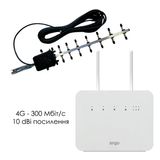
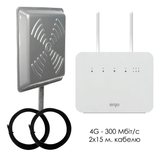
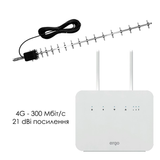
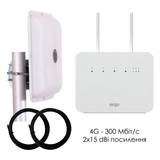
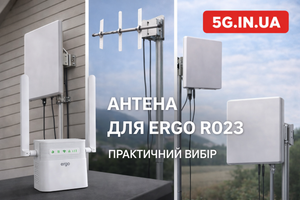
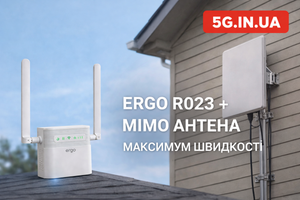
In field, mobile, or temporary points, signal reception is often the bottleneck. Having two SMA connectors for an external MIMO antenna means you do not have to treat weak indoor reception as a given. You can actually improve the channel. For rapid deployment, this matters: an external antenna often saves the scenario without changing the whole hardware setup.
Autonomous Operation for Up to 7 Hours Is Not a Bonus, but a Working Advantage
ERGO R291B is equipped with a 4000 mAh battery and can operate autonomously for up to 7 hours. For mobile and field tasks, this is one of its strongest properties. If the main power at the site goes out, the router does not shut down instantly. This gives time to maintain communication, receive notifications, finish coordination, or switch the system into another mode.
Practical Usage Scenarios
Small Headquarters Setup for 3–10 People
Laptops, browser work, spreadsheets, documents, messengers, printing, several smartphones, and one or two cameras. This is a typical scenario where ERGO R291B looks natural.
Humanitarian Coordination Point
Records, communication, photos, web forms, supplier contacts, and basic cloud access. Here, the speed of deployment and mobility matter more than complicated fixed infrastructure.
Temporary Communication Point in a Field Premises
When the premises are not adapted for a classic office or the location changes, a 4G router with a battery and external antenna looks more logical than any attempt to quickly “pull a cable.”
Backup for a Working Point
Even if there is already a main internet channel, ERGO R291B can serve as a separate backup channel that does not depend on the same wired setup.
How to Build This Type of Connectivity Properly
1. First Define the Critical Layer
Do not hang everything on the link immediately. Define what matters most: laptops, printer, messengers, camera, documents, browser work, spreadsheets, terminal.
2. Test Operators at the Specific Location
At different points, one operator may work noticeably better than another. For rapid deployment, this is one of the most valuable steps.
3. Place the Router Where There Is Signal, Not Where It Is “Convenient”
Do not put it under a table, inside a sealed box, or inside a metal cabinet. Better near a window, an outer wall, or a point where an antenna can be connected.
4. Use Ethernet for Critical Nodes
If there is an option to connect a key laptop, camera, NVR, or switch by cable, that is better than relying only on Wi-Fi.
5. Do Not Neglect an External Antenna
In difficult radio conditions, it often provides more benefit than any attempt to “find a better place” inside the room.
Honest Limitations: When This Solution May Not Be Suitable
A 4G router for fast deployment is a strong scenario, but not a universal answer to everything.
Very Weak or No LTE Coverage
If the mobile network practically does not work at the specific point, a router alone will not solve the problem. Here, an external antenna, another operator, or another access scheme is needed.
Excessively Heavy Traffic
If one channel is expected to carry massive video, large uploads, cloud backups, many cameras, and dozens of active users at the same time, performance will drop.
No Backup Power for Everything Else
The router itself can work autonomously for up to 7 hours, but if the rest of the site is fully unpowered, overall operability will still be limited.
Unrealistic Expectations of “Mobility Without Setup”
Fast deployment does not mean no preparation at all. The operator, installation point, antenna, and basic network logic still matter.
Why ERGO R291B Looks Like a Balanced Choice
The market offers either overly simple mobile routers or more expensive setups that are excessive for temporary, field, or mobile tasks. ERGO R291B looks balanced because it combines exactly the characteristics that matter here:
-
LTE Cat.7 and 2CA
-
AC1200 Wi-Fi 2.4 / 5 GHz
-
1× WAN/LAN + 3× LAN 10/100/1000
-
2× SMA for external LTE antennas
-
support for up to 32 users
-
4000 mAh battery
-
autonomous operation for up to 7 hours
This does not make it an automatic solution for any location without preparation. But for the scenario of rapidly deploying connectivity at a mobile, field, or temporary site, this configuration looks technically logical.
Conclusion
Internet for military, humanitarian, and field headquarters tasks where fast deployment is required should be judged not by attractive words, but by real behavior in practice: how quickly the link came up, whether critical nodes can be connected, whether there is reception headroom, and whether communication survives power interruptions.
That is exactly why a 4G router with proper network architecture, support for external antennas, and its own battery looks much more practical than random or temporary solutions. ERGO R291B fits this scenario well because it combines LTE Cat.7, LAN ports, dual-band Wi-Fi, 2× SMA, and autonomous operation for up to 7 hours.
FAQ
Is 4G suitable for rapid deployment of connectivity at a temporary location?
Yes. This is one of its main advantages: no wired installation, no separate provider entry, and no long wait for connection.
Why is ERGO R291B better than internet sharing from a smartphone?
Because it is a separate network node with LTE Cat.7, 1× WAN/LAN + 3× LAN 10/100/1000, dual-band Wi-Fi, 2× SMA for an antenna, support for up to 32 users, and a 4000 mAh battery. A smartphone is only a temporary improvisation.
Can an external antenna be connected?
Yes. ERGO R291B has 2× SMA for an external LTE MIMO antenna. This is especially important in difficult reception conditions.
How long does the router work without electricity?
ERGO R291B can operate autonomously for up to 7 hours from its built-in 4000 mAh battery.
Is it enough for laptops, messengers, documents, and basic coordination?
Yes. For that type of working layer, this is a realistic scenario. That is exactly why the model has both Wi-Fi and LAN ports, along with LTE capacity headroom.
When might this solution not be suitable?
When the location has almost no LTE, when the traffic is too heavy, or when the rest of the infrastructure has no power and cannot function even if the channel exists.
Can ERGO R291B be not only a main but also a backup channel?
Yes. If the site already has another internet connection, ERGO R291B can work as an independent backup channel.