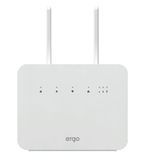
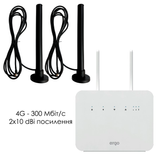
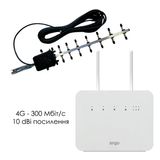
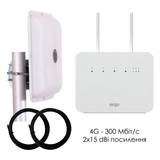
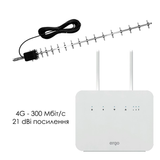
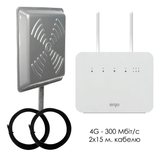
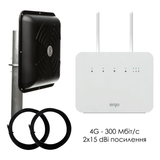
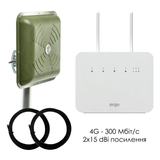
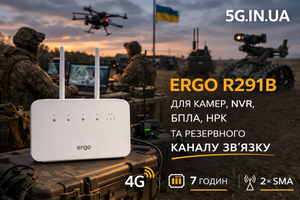
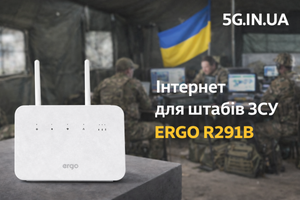
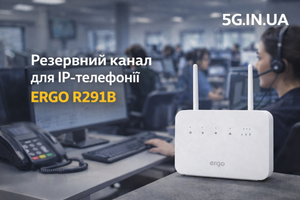
Internet for a mobile retail point or field sales is needed not for convenience, but for business operations: a POS terminal, bank acquiring, software cash register, seller’s tablet, staff smartphones, inventory system, messengers, online orders, cameras, and a backup communication channel. In this sales format, the key factor is not maximum speed on paper, but stable startup, autonomy, simple connection, and clear network logic. That is why the ERGO R291B 4G WiFi router fits this scenario well: it can work through a SIM card, supports a local network for business equipment, and its built-in battery provides up to 7 hours of autonomous operation. For a coffee point, fair kiosk, mobile food court, sales trailer, seasonal stand, promo zone, or temporary cashier point, this means one thing: internet starts quickly, works without unnecessary complexity, and does not require fixed infrastructure where there is none or where it is inconvenient.
Why internet for field sales is a separate task rather than “just use any router”
In a fixed store everything is simpler. There is a room, there are power outlets, often there is an internet provider, sometimes Ethernet is already installed, and the router stays in one place. In mobile retail or field sales, the conditions are completely different: the location may change, the point may operate at a fair, inside a mall, outdoors, at a festival, near a highway, on a seasonal site, in a food truck, retail tent, or temporary pavilion.
Under these conditions, internet must solve not the abstract task of “providing Wi-Fi,” but the practical task of making sales work. If connectivity drops, the consequences are specific: card payments fail, the cash register does not sync, the software cash register cannot send data, the seller’s tablet freezes without system access, the manager cannot see inventory, the customer waits, the line grows, and the point loses money.
That is why the right solution for mobile retail is not a random home router and not internet sharing from a seller’s smartphone, but a dedicated 4G router that works as an actual network node for the retail point.
What kind of internet a mobile retail point really needs
In most such scenarios, the needs are highly practical:
Card payments and banking services
A payment terminal, online acquiring, access to payment services, and transaction confirmations depend on a stable channel. Even short interruptions are critical here.
Operation of software cash register systems
A cash register, tablet, laptop, or POS system must have internet access for data transfer, synchronization, and stable operation during the whole shift.
Access to inventory, stock levels, and orders
Field sales often use simplified but still active digital infrastructure: spreadsheets, CRM, messengers, stock records, online store tools, internal chats, order forms, and delivery coordination.
Simultaneous connection of several devices
A point may have the seller’s tablet, smartphone, terminal, manager’s laptop, receipt printer, sometimes a camera, and sometimes a separate phone for customer communication.
Autonomy
Power at a mobile point is not always stable. At fairs, field events, and temporary sites there may be short outages, weak extension lines, overloaded circuits, or situations where power itself is only temporary. Internet must not disappear instantly because of any small disruption.
Why 4G is the base solution for field sales
In most cases, a mobile retail point makes no sense when built around wired internet. There may be no provider on site. Even if there is one, connecting for one day, one week, or one season is often pointless. In a food truck, mobile island stand, exhibition zone, or temporary retail pavilion, internet must launch quickly and without bureaucracy.
That is exactly where 4G becomes the most rational option. There is operator coverage, there is a SIM card, there is a router, and the point gets a working communication channel. There is no need to pull cable, wait for installation, coordinate a connection with site management, or depend on someone else’s Wi-Fi that may exist today and disappear tomorrow.
For business, this matters for one reason: mobile retail makes money when it launches quickly and works predictably.
Why smartphone tethering is a weak solution
Many people at the start try to manage with a phone. It looks convenient: turn on hotspot mode and work. In practice, this is a weak setup.
A smartphone is not a network node for a retail point. It overheats, drains faster, may lose connection, may accidentally turn off the hotspot, may leave the site with the seller, may switch between power-saving modes, or simply work unstably under load. On top of that, it is poor infrastructure discipline: one employee’s personal device becomes a critical element of sales for the whole point.
As soon as a point has a cash register, terminal, tablet, and a need for stable operation of multiple devices, the smartphone stops being a real solution. At that stage, a separate router is already needed.
Where ERGO R291B fits into the mobile retail task
ERGO R291B fits this scenario well not because of one loud specification, but because of the combination of characteristics needed specifically in field commercial conditions.
1. Fast startup through a SIM card
For field sales, this is critical. The point often has to be deployed quickly: the team brings the equipment, sets up the table or stand, connects power, inserts the SIM card, and starts working. The fewer launch stages, the fewer chances there are for failure.
2. A proper local network for retail equipment
A mobile point is no longer just one phone. A cash register tablet, payment terminal, laptop, staff smartphones, printer, or other devices may all work at the same time. In that situation, a separate router is the right approach because it creates a proper network foundation for the whole point.
3. Suitable for a backup scenario
Some field retail points are placed in locations where local internet or organizer-provided Wi-Fi exists. The problem is that “there is Wi-Fi” does not mean “you can build sales on it.” If that external network becomes unstable, the point freezes with it. In that case, ERGO R291B is useful as an independent channel not tied to someone else’s infrastructure.
4. Autonomous operation for up to 7 hours
For mobile retail, this is one of the strongest practical advantages. If power disappears at the site, the router does not shut off immediately and can continue operating autonomously for up to 7 hours. For field sales, this means keeping connectivity for the cash register, terminal, manager, or basic operations even during power problems.
Where it works best: typical scenarios
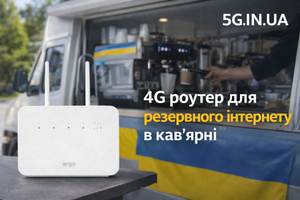
Internet for a food truck or coffee point
A food truck, mobile coffee bar, seasonal drinks stand, or fast-food point is one of the most typical scenarios. There is customer flow, fast purchases, card payments, sometimes an online menu, messengers, internal communication, and a constant need for everything to work without delays.
In such a scenario, ERGO R291B is appropriate as the dedicated communication center of the point. It does not depend on the barista’s or seller’s smartphone and does not require a fixed provider. This becomes especially important during peak hours, when even a short failure costs sales.
Internet for a fair, festival, or exhibition
At fairs and festivals there is almost always one problem: many people, many devices, an overloaded radio environment, and not always predictable connection quality. If the point depends on random public Wi-Fi or on a phone, the risk of problems is high.
A dedicated 4G router provides a more controlled scenario. The point has its own channel that is not shared with everyone around it and works according to its own logic. This does not guarantee perfect connectivity in every crowded environment, but it is far more professional than building retail operations on a random network.
Internet for a seasonal pavilion or island stand
Seasonal retail often works in a semi-fixed format: a summer point, temporary pavilion, retail zone near a beach, park, highway, or market. There may be electricity, but not always internet. And if internet exists, it often depends on the landlord or event organizer.
In this format, ERGO R291B solves the main problem: the point has its own internet and does not depend on whether someone provided “good Wi-Fi.” For business, that means fewer surprises and more control.
Internet for event-based field sales
Promo stands, branded zones, mobile retail points at concerts, sporting events, city celebrations, or corporate events often operate for just a few hours or one day. Nobody is going to build complex infrastructure there. What is needed is internet that arrives with the team, turns on, and works.
That is exactly the natural scenario for ERGO R291B.
What tasks the router actually covers at a retail point
Through ERGO R291B, a mobile or field retail point can organize operation of:
-
a payment terminal;
-
the seller’s tablet or laptop;
-
software cash register tools;
-
staff smartphones;
-
a receipt printer or related equipment;
-
working access to CRM, spreadsheets, chats, and orders;
-
a backup communication channel;
-
cameras or basic remote monitoring, if needed at the point.
This is exactly the typical working configuration of a small mobile business.
Why maximum speed matters less here than stability
In field sales, people often mistakenly think in terms of “the higher the speed, the better.” In reality, most mobile retail points do not need enormous speeds. They need a stable channel for light to medium traffic that does not collapse during payment or product handoff.
Card payments, receipt transmission, CRM work, messaging, order synchronization, and stock access are not tasks that require record-breaking throughput. They require predictability. That is why a router for this scenario is judged not by marketing megabits, but by whether normal sales operations can run on it.
How to think correctly when launching a mobile retail point
A router alone is not a magical answer to everything. A working scenario is built from several components.
Operator coverage quality at the exact site
A fair location in the city center, a food court near a highway, a festival site in an open field, and a seasonal point near a market are four different conditions. Before launch, it is important to check how the exact operator works in the exact location where the point will operate.
Correct router placement
Even in mobile retail, placement matters. If the router is inside a metal cabinet, blocked by equipment, squeezed between power supplies, or placed in a blind part of the structure, connection quality may be worse than with a proper open placement.
Network load
One terminal and one tablet is a simple scenario. Several cash desks, several smartphones, constant synchronization, video surveillance, and extra staff connections create a different load level.
Power for the whole point, not only for the router
ERGO R291B can operate autonomously for up to 7 hours, but if the point also has a terminal, tablet, printer, cash equipment, or camera, backup power must be planned for the entire working setup.
When ERGO R291B is especially appropriate
When the point changes location often
Mobile points, field sales, seasonal stands, retail trailers, and festival retail all operate with frequent movement and repeated setup. ERGO R291B fits well precisely because it does not tie internet to one address.
When autonomy is critical
For points that operate under temporary or unstable power conditions, up to 7 hours of autonomy is not a bonus, but real protection against interrupted sales.
When several devices need to be connected into one network
If the business has already grown beyond the format of “one phone and one seller,” a separate 4G WiFi router becomes a logical tool.
When an independent private channel is needed
Building sales around someone else’s Wi-Fi is always a risk. Your own SIM-based router gives the point independence and better predictability.
When this solution may not fit
An honest choice of equipment always includes its practical limits.
Locations with very weak or overloaded 4G
If the point operates in a place with poor coverage or in an area where the mobile network is constantly overloaded, the router itself will not create a good channel out of thin air. In that case, operators, placement, and depending on the point format, another connection scheme must be tested.
Very large retail scenarios
If this is no longer a mobile point but a large temporary retail space with many cash desks, many staff members, video surveillance, guest Wi-Fi, and high traffic, one 4G router may be insufficient. That already requires separate network design.
Retail inside structures that strongly block signal
Metal containers, closed retail modules, difficult pavilions, or points inside structures with poor signal penetration may require different equipment placement or additional solutions.
Dependence on one operator without testing
If the business travels to different locations and uses one SIM card that has never been tested at a new site, that is a risk. In field sales, a backup connection scenario is often almost as important as the router itself.
Practical launch logic without mistakes
To make internet at a mobile retail point work predictably, the sequence is simple:
Step 1. Determine which devices will actually operate
Terminal, cash register, tablet, smartphones, printer, camera — all this creates requirements for the access point.
Step 2. Check mobile coverage at the future site
Not from a marketing map, but in reality at the location or at least based on comparable past sites.
Step 3. Do not rely on a personal phone
The seller’s smartphone is a weak foundation for stable retail operations.
Step 4. Plan the power supply
If the site has unstable electricity, up to 7 hours of router autonomy is a major advantage, but critical devices also need their own power reserve.
Step 5. Build the point around a working operational scheme, not around random improvisation
A retail point should have its own internet just as naturally as it has a cash register or payment terminal.
Why ERGO R291B is a logical choice specifically for mobile retail
For this scenario, balance is what matters. There is no need for a bulky enterprise-class solution. At the same time, consumer-level improvisation based on a phone is not suitable either. What is needed is a compact, understandable, sufficiently autonomous, and daily-usable network node.
That is exactly how ERGO R291B looks in the context of field sales. It allows fast connectivity launch through 4G, creates a working network for several devices, removes dependence on external infrastructure, and keeps internet running during power problems thanks to up to 7 hours of autonomous operation.
For food trucks, fair retail points, seasonal pavilions, temporary cashier zones, mobile stands, and field sales, this is a very practical combination.
Conclusion
Internet for a mobile retail point or field sales is part of the sales process, not a secondary detail. Without it, the terminal, cash register, software cash register, access to business systems, and communication with the team do not work. In this business format, fast deployment, independence from чужих мереж, a proper local infrastructure, and survivability during power problems matter.
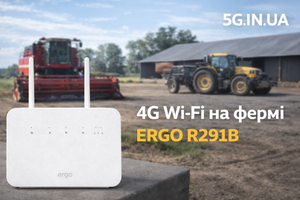
ERGO R291B fits these tasks well. It is suitable for 4G access at temporary and mobile locations, allows several devices to work within one network, and can operate autonomously for up to 7 hours from its built-in battery. For mobile retail, this is not an abstract advantage, but a real resilience reserve.
If you need a working 4G WiFi router for a mobile retail point, field sales, a fair, food truck, or seasonal pavilion, ERGO R291B is worth considering as a practical solution without unnecessary complexity. You can order ERGO R291B from the 5G.IN.UA online store.
FAQ
Is ERGO R291B suitable for card payments at a mobile retail point?
Yes. It fits well in scenarios where stable internet is needed for a payment terminal, online acquiring, a cashier tablet, or software cash register tools.
Can ERGO R291B be used in a food truck or mobile coffee point?
Yes. This is one of the most natural scenarios for such a router because it allows quick internet deployment without a fixed provider.
How long can ERGO R291B work without electricity?
From its built-in battery, the router can operate autonomously for up to 7 hours. For full point autonomy, power for the terminal, tablet, cash register, and other equipment should also be planned separately.
Is smartphone hotspot enough instead of a router?
For occasional tasks, some people do use it, but for stable retail operations it is a weak setup. A dedicated router is more reliable, more convenient, and better suited for connecting several devices.
Is ERGO R291B suitable for fairs and festivals?
Yes. At such events, a private 4G channel is often much more reliable than random shared Wi-Fi or tethering from a phone.
Can one router be insufficient?
Yes. If the point is large, has many cash desks, significant load, or works in a place with difficult coverage, another network scheme or additional equipment may be needed.
Who is ERGO R291B the best fit for?
For mobile retail points, food trucks, coffee stands, fair sellers, seasonal pavilions, temporary cashier zones, field retail, and all scenarios where dedicated 4G internet with up to 7 hours of autonomous operation is needed.