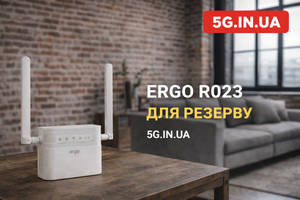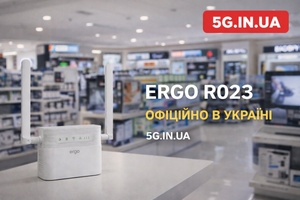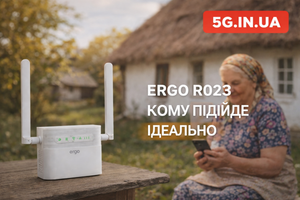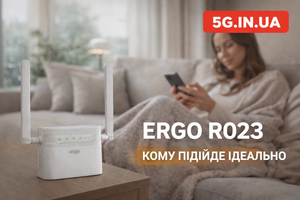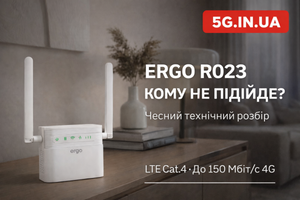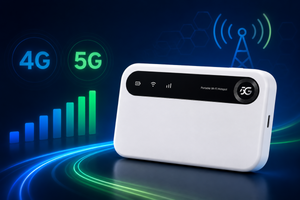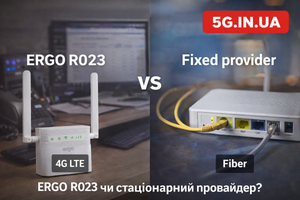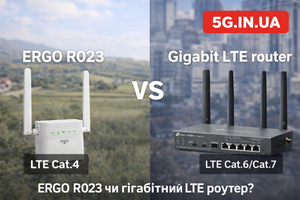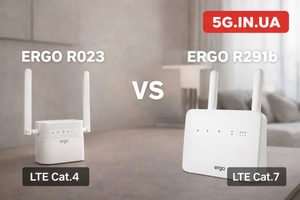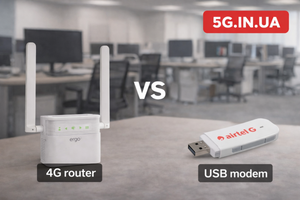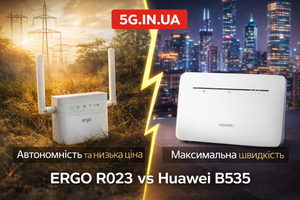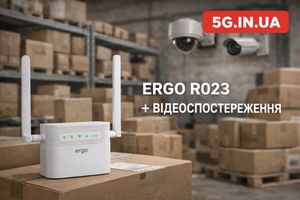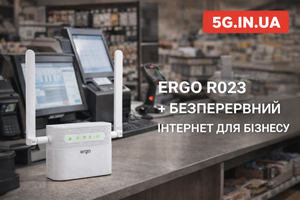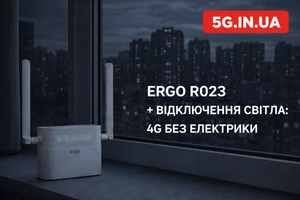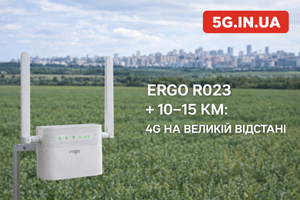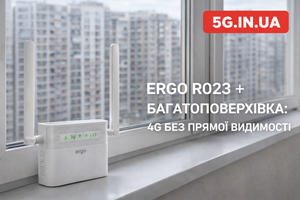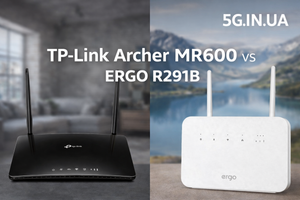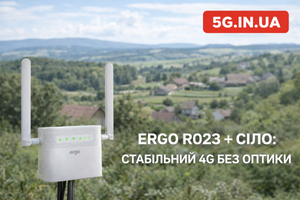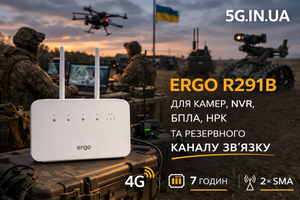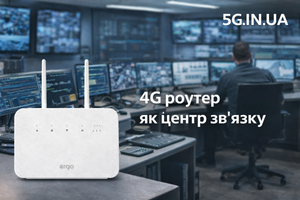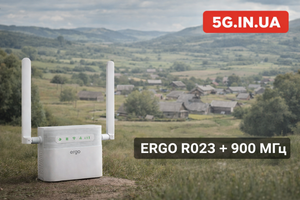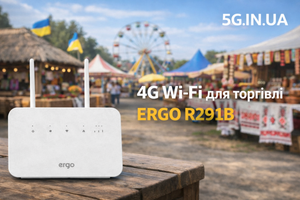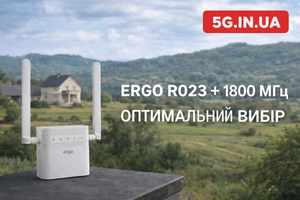
ERGO R023 is a stationary 4G LTE Wi-Fi router with a built-in battery, external SMA antenna connectors, and LAN/WAN ports, designed for home, office, and backup internet scenarios. A mobile MiFi is a compact pocket device intended for travel and short-term use. If you need stable coverage, the ability to connect external antennas, operation during power outages, and wired internet failover — ERGO R023 is functionally stronger. If you need internet “in your pocket” for a few hours — MiFi is more compact. The right choice depends on the usage scenario, not the marketing label.
What Is ERGO R023 and What Is a Mobile MiFi
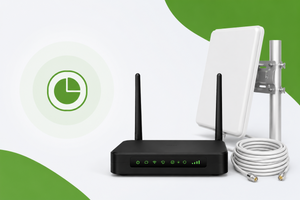
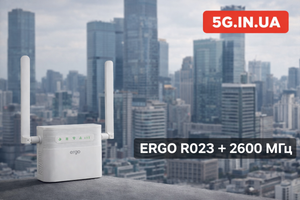
ERGO R023 is a 4G LTE Wi-Fi router (LTE Cat.4 up to 150/50 Mbps) with a 4000 mAh built-in battery, two SMA connectors for external MIMO antennas, one WAN/LAN port, and one LAN port. It supports SIM cards from Ukrainian operators in 900/1800/2600 MHz bands. It can use 4G as the primary or backup connection.
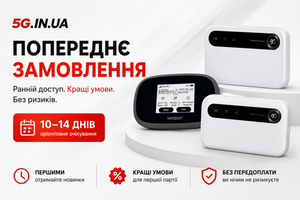
Mobile MiFi is a compact 4G router with a battery, typically without LAN ports and usually without full-size SMA connectors for external antennas. It is designed for mobility: travel, business trips, temporary connectivity.
From a marketing perspective, both “share Wi-Fi from a SIM card.”
From an engineering perspective, they belong to different hardware classes.
Architectural Difference: Pocket Device vs Semi-Stationary Solution
Power and Autonomy
ERGO R023 has a 4000 mAh battery and 12V/1A power supply. This results in:
-
more stable operation under load,
-
ability to function as a mini-UPS during short outages,
-
better thermal stability during long sessions.
A typical MiFi has a 1500–3000 mAh battery and 5V charging via microUSB/USB-C. When operating continuously while charging, it heats up more, which affects battery lifespan.
Practical example:
During a blackout in an apartment, ERGO R023 continues running for several hours without dropping camera or laptop connections. A MiFi under similar load often shuts down earlier or reduces Wi-Fi performance to save power.
Ports and Network Topology
ERGO R023 includes:
-
1× WAN/LAN (for wired internet input),
-
1× LAN,
-
2× SMA Female connectors for MIMO antennas.
A typical MiFi includes:
-
Wi-Fi only,
-
sometimes a microUSB port for charging,
-
no full Ethernet infrastructure.
This defines different use cases:
-
ERGO R023 can act as the core of a home network.
-
MiFi is a temporary hotspot for 3–10 devices without wired integration.
ERGO R023 and External Antennas: A Critical Advantage
Most mobile MiFi devices do not have full-size SMA connectors for directional MIMO antennas. Yet in real LTE deployments, the antenna often determines performance.
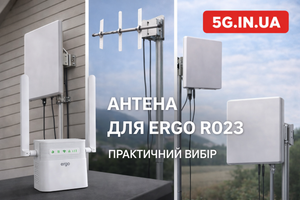
ERGO R023 allows you to:
-
connect a panel MIMO 2×2 antenna,
-
mount it outside on a wall or roof,
-
operate at the edge of coverage.
Engineering logic is simple:
LTE operates on radio frequencies. If RSRP is weak (e.g., −105 dBm), speed drops regardless of modem category. An external antenna can improve signal strength to −85 dBm — significantly increasing throughput.
A MiFi without antenna connectors cannot compensate for weak coverage. It depends entirely on its internal micro-antennas.
Practical scenario:
Private house located 12 km from a base station. MiFi shows 5–10 Mbps. ERGO R023 with an external 1800 MHz antenna achieves 30–70 Mbps under the same tariff plan.
Internet Failover: What MiFi Typically Lacks
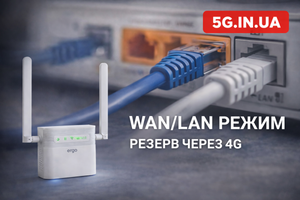
ERGO R023 can receive wired internet through its WAN port and automatically switch to 4G as backup.
This means:
-
if your ISP fails, connectivity remains active,
-
video surveillance and POS terminals stay online,
-
remote access sessions are not interrupted.
MiFi cannot integrate into such failover schemes. It does not function as a backup router within an existing wired infrastructure.
For shops, warehouses, and offices, this difference is operationally critical.
LTE Cat.4 Performance in Practice
ERGO R023 supports LTE Cat.4:
-
up to 150 Mbps download,
-
up to 50 Mbps upload,
-
no carrier aggregation (no CA).
Most budget MiFi devices are also Cat.4.
Therefore, modem class may be similar. The real difference lies in:
-
antenna capability,
-
power stability,
-
thermal management,
-
Wi-Fi hardware quality.
For typical users, Cat.4 is sufficient for:
-
1080p YouTube,
-
video calls,
-
cloud services,
-
IP cameras.
Actual speed depends more on base station load and signal quality than on theoretical modem numbers.
Wi-Fi Coverage: Size Matters
MiFi is designed for:
-
a single room,
-
a car,
-
a small open space.
ERGO R023 uses full-size Wi-Fi hardware (2.4 GHz 802.11 b/g/n up to 300 Mbps). Its coverage area is larger.
In practice:
-
in a 60–80 m² apartment, ERGO R023 covers most of the space,
-
MiFi often requires central placement and still struggles through walls.
Usage Scenarios
When MiFi Is Logical
-
business trips,
-
car use,
-
travel abroad,
-
short-term connectivity.
Portability is its core advantage.
When ERGO R023 Is Logical
-
apartment without fiber,
-
private house,
-
rural property,
-
shop or small business,
-
backup internet channel,
-
regions with unstable electricity supply.
Limitations
ERGO R023 is not universal.
Limitations:
-
LTE Cat.4 without carrier aggregation — not maximum speed in congested urban networks.
-
Wi-Fi only 2.4 GHz — possible interference in dense apartment buildings.
-
No 5G support.
-
Requires correct antenna selection for weak signal areas.
-
Not pocket-sized — less mobile than MiFi.
MiFi limitations:
-
Limited Wi-Fi coverage.
-
No wired LAN infrastructure.
-
Often no full-size antenna connectors.
-
Lower autonomy under heavy load.
-
Cannot function in failover configurations.
Economic Logic
MiFi is cheaper as a “travel device.”
ERGO R023 is more cost-effective long-term if you need:
-
external antenna integration,
-
backup connectivity,
-
stable daily operation.
Using a MiFi as a permanent home router is a compromise.
Security and Monitoring
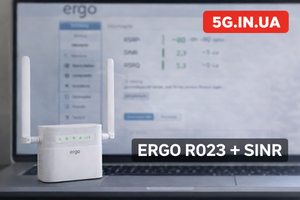
ERGO R023 provides a web interface (192.168.1.1) with engineering information:
-
RSRP,
-
RSRQ,
-
SINR.
This allows you to:
-
correctly align external antennas,
-
evaluate channel quality,
-
make informed technical decisions.
Many MiFi interfaces hide or simplify such metrics.
ERGO R023 as Part of a 4G Kit
The key difference becomes clear in a complete setup:
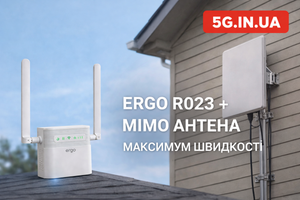
ERGO R023 + directional MIMO antenna = predictable performance.
MiFi + internal antennas = signal-dependent performance.
For rural deployments, this difference is decisive.
Conclusion
ERGO R023 and mobile MiFi solve different problems.
MiFi prioritizes mobility and compact size.
ERGO R023 prioritizes stability, scalability, and network integration.
If you need internet “on the go” — MiFi makes sense.
If you need internet “that simply keeps working” — ERGO R023 is the technically justified choice.
On 5G.IN.UA, ERGO R023 is presented with detailed specifications, antenna recommendations, and real-world deployment scenarios. Before purchasing, define your use case — then select the equipment accordingly.
FAQ
1. Can ERGO R023 replace a home router?
Yes, if 4G is your primary connection or if you need a SIM-based backup channel.
2. Is ERGO R023 faster than MiFi?
Modem class may be similar (Cat.4). In real conditions, ERGO R023 can perform better due to external antennas and stable power.
3. Can I connect an external antenna to MiFi?
Most models do not support full-size antenna connectors.
4. Is ERGO R023 suitable for business use?
Yes, especially as a backup channel or main connection in locations without fiber.
5. How long does ERGO R023 work without power?
Depends on load, but the 4000 mAh battery allows several hours of autonomous operation.
6. Does ERGO R023 support 5G?
No, it is a 4G LTE device.
7. What is better for rural areas?
ERGO R023 combined with a properly selected external antenna is technically more appropriate than a MiFi without signal enhancement capability.
ERGO R023 is not just “another 4G router” — it is a tool for controlled and predictable mobile internet deployment. The choice between it and a mobile MiFi should be based on engineering logic, not device size.