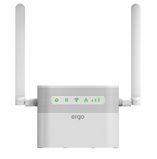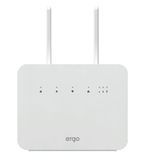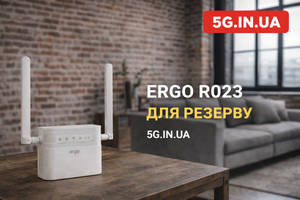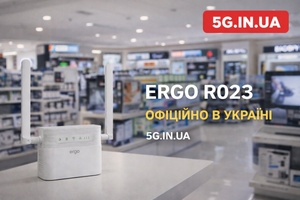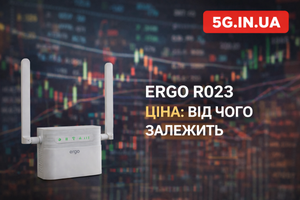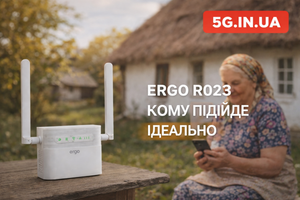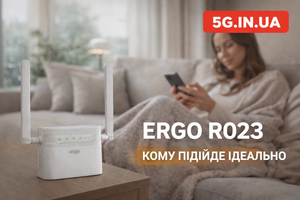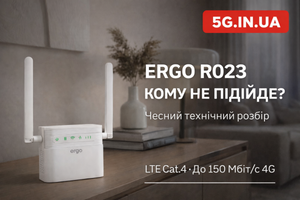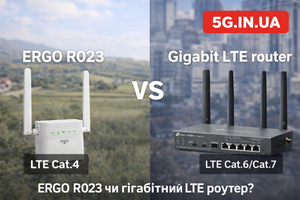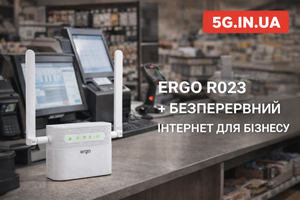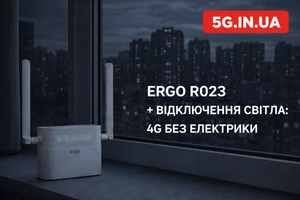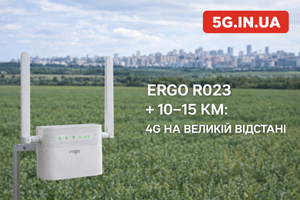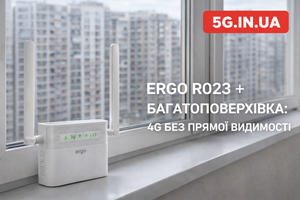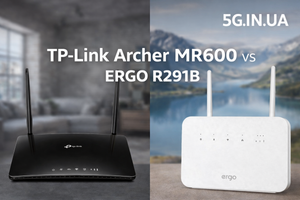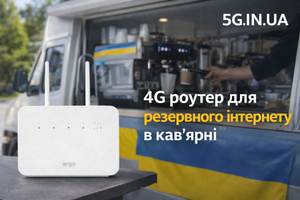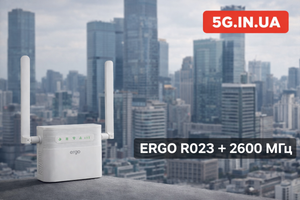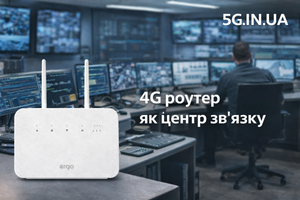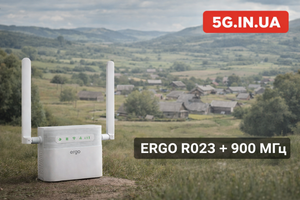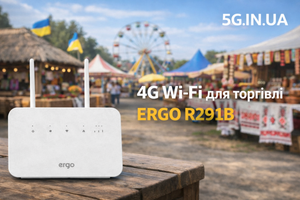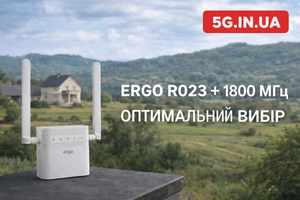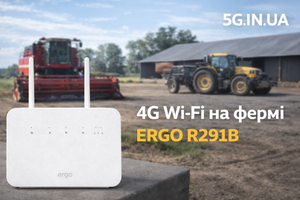
ERGO R023 is a 4G LTE Cat.4 router (up to 150/50 Mbps) with a 4000 mAh battery, 2×SMA connectors, and WAN/LAN failover support. ERGO R291b is a LTE Cat.7 router (up to 300/100 Mbps) with Carrier Aggregation, Wi-Fi AC1200 (2.4/5 GHz), 2×SMA connectors, Gigabit LAN ports, and the same 4000 mAh battery. The difference between them becomes noticeable only if Carrier Aggregation is active at your location and signal quality is sufficient. In many real-world conditions, ERGO R023 delivers the same practical result. The correct choice should be based on network capability and use case — not just LTE category.
What LTE Cat.4 and Cat.7 Mean in Real Use
LTE category defines the theoretical maximum modem speed.
-
LTE Cat.4 — up to 150 Mbps download and 50 Mbps upload, no Carrier Aggregation.
-
LTE Cat.7 — up to 300 Mbps download and 100 Mbps upload with Carrier Aggregation (CA).
Carrier Aggregation allows combining two frequency bands (for example 1800 + 2600 MHz), increasing total bandwidth.
Theoretically, Cat.7 is faster.
Practically, only if your operator supports CA at your specific location and signal quality allows it.
ERGO R023: A Balanced 4G Solution
ERGO R023 is a stationary and portable 4G LTE router with:
-
LTE Cat.4 (150/50 Mbps)
-
900 / 1800 / 2600 MHz support
-
2×SMA connectors for LTE MIMO 2×2
-
Wi-Fi 2.4 GHz 802.11 b/g/n
-
1× WAN/LAN + 1× LAN
-
4000 mAh battery
Its logic is simple: sufficient speed + external antenna capability + battery backup.
For most real-world scenarios, 150 Mbps is more than enough. Actual 4G speeds are often limited by base station load, not modem category.
ERGO R291b: What LTE Cat.7 Really Adds
ERGO R291b is a 4G Wi-Fi router with:
-
LTE Cat.7 (up to 300/100 Mbps)
-
Carrier Aggregation support
-
Wi-Fi AC1200 (2.4 GHz + 5 GHz)
-
1× WAN/LAN + 3× LAN (10/100/1000)
-
2×SMA connectors for LTE MIMO 2×2
-
4000 mAh battery
-
Support for up to 32 users
Important: ERGO R291b also includes a 4000 mAh battery, so autonomy is not a disadvantage compared to ERGO R023.
Its key differences:
-
Carrier Aggregation support.
-
Dual-band Wi-Fi with 5 GHz.
-
Gigabit LAN ports.
Practical Scenarios: When Cat.7 Makes Sense
Scenario 1: Rural area, single base station
-
Only one band available (for example 1800 MHz)
-
RSRP −95 to −105 dBm
-
No Carrier Aggregation
In this case, ERGO R023 and ERGO R291b will perform similarly. Cat.7 provides no real advantage.
Scenario 2: Urban area, active CA (1800 + 2600 MHz)
-
Strong signal
-
Two aggregated bands
-
Low interference
Here ERGO R291b may reach 180–250 Mbps or more. ERGO R023 is limited to 150 Mbps.
The real question is whether you actually need that speed.
Wi-Fi AC1200 vs 2.4 GHz Only
ERGO R291b supports Wi-Fi AC1200:
-
2.4 GHz — better wall penetration
-
5 GHz — higher throughput and less interference
ERGO R023 operates only on 2.4 GHz. In apartments with many neighboring networks, 5 GHz can be beneficial.
However, if your internet speed is limited to 40–80 Mbps, the practical difference between AC1200 and 2.4 GHz may be minimal.
Antennas: A Critical Equal Factor
Both ERGO R023 and ERGO R291b feature 2×SMA connectors for external LTE antennas in MIMO 2×2 configuration.
In weak-signal conditions, the antenna — not modem category — often determines performance.
Engineering logic:
Improving RSRP from −105 dBm to −85 dBm often provides a greater speed increase than upgrading from Cat.4 to Cat.7 without improving signal quality.
WAN/LAN and Failover
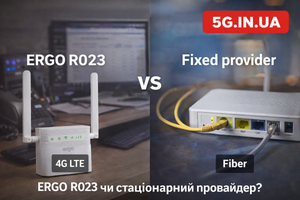
Both models support the scenario:
“Wired internet + automatic switch to 4G.”
ERGO R291b includes Gigabit LAN ports, useful for high-speed wired internet.
ERGO R023 also supports WAN/LAN but is oriented toward moderate speeds.
For backup internet, both models are technically suitable.
Battery Backup: Equal Position
Both ERGO R023 and ERGO R291b include a 4000 mAh battery.
Operating time depends on:
-
signal strength
-
number of connected devices
-
Wi-Fi usage
-
Carrier Aggregation activity
In terms of autonomy, there is no major difference.
Limitations
ERGO R023 Limitations
-
LTE Cat.4 — no Carrier Aggregation.
-
Wi-Fi limited to 2.4 GHz.
-
Theoretical maximum 150 Mbps.
-
LAN ports may not be Gigabit (depending on revision).
ERGO R291b Limitations
-
Higher price.
-
Cat.7 advantage works only with active CA.
-
Requires strong signal to unlock full potential.
-
Slightly more complex configuration for advanced scenarios.
When to Choose ERGO R023
-
No Carrier Aggregation at your location
-
Moderate or weak signal
-
Backup internet use
-
Budget-sensitive scenario
-
No need for 5 GHz Wi-Fi
When to Choose ERGO R291b
-
Active Carrier Aggregation in your area
-
Need for maximum speed
-
5 GHz Wi-Fi required
-
High-speed wired internet integration via WAN
ERGO R023 and ERGO R291b are not “better vs worse” devices — they offer different levels of potential.
Cat.7 is technically faster.
But without Carrier Aggregation, it does not provide an advantage.
In many real-world conditions, ERGO R023 delivers the same stable performance.
On 5G.IN.UA, both models are presented as part of a specialized 4G/LTE solution lineup. Before purchasing, evaluate signal quality, CA availability, and actual speed requirements. A rational choice is one that matches real network conditions at your location.
FAQ
1. Is Cat.7 always faster than Cat.4?
No. Only if Carrier Aggregation is available.
2. Does ERGO R291b have a battery?
Yes, 4000 mAh.
3. Is 150 Mbps enough for home use?
Yes, for most use cases it is more than sufficient.
4. Does ERGO R023 support Carrier Aggregation?
No, it is LTE Cat.4.
5. Is improving signal more important than upgrading to Cat.7?
In most cases, yes.
6. Do both routers support 2×SMA connectors?
Yes, both support MIMO 2×2 via SMA.
7. Can both be used as backup internet?
Yes, both support WAN/LAN + 4G failover scenarios.