5G in Ukraine: why buyers should require support for n78 and n28
Buying a router for several years of Ukrainian 5G use? Check n78 and n28 support in the exact variant. A “5G” label, US origin and a long list of other bands do not replace the bands you need.
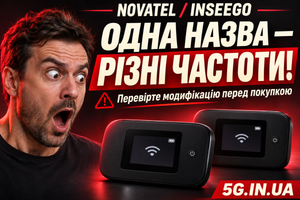
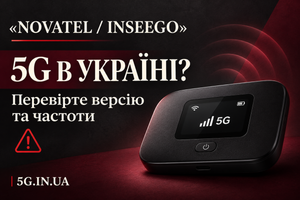
Do not buy Novatel / Inseego for 5G in Ukraine—that is our editorial recommendation for buyers seeking to avoid confusion over carrier versions. The technical basis is the limitations of particular variants, not an assumption that every device from the brand is identical.
For the broader analysis, read Novatel / Inseego for Ukrainian 5G: frequency bands and marketing claims.
Two bands serve different purposes
In its article on 5G development, Kyivstar identifies 3500 MHz for high speeds and 700 MHz for wider coverage. Its Odesa testing announcement confirms the use of 3500 MHz in NSA mode.
When choosing a router for these deployment bands, n78 and n28 matter. Plans to use 700 MHz do not mean n28 is already available everywhere.
| Band | Why it matters | Consequence of missing support |
|---|---|---|
| n78 — around 3500 MHz | Connection to relevant 5G networks focused on speed and capacity | The router cannot connect to n78 5G |
| n28 — around 700 MHz | Readiness for wider-coverage 5G deployment | The router cannot connect to n28 5G |
The bands complement each other. Supporting n78 does not add n28, and supporting n28 does not add n78.
No n78: do not buy it for an n78 network
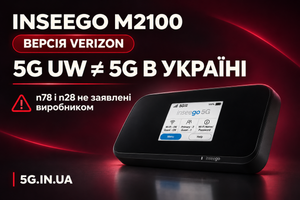
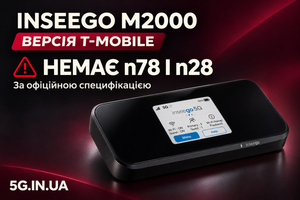
The official M2000 T-Mobile datasheet lists 5G n2/n41/n66/n71. The M2100 Verizon guide lists n2/n5/n66/n260/n261. Neither list includes n78 or n28.
For buyers needing Ukrainian n78 5G, this is sufficient reason to reject those versions with the cited specifications.
See the detailed reviews of the M2000 T-Mobile without n78 and n28 and the M2100 Verizon for Ukraine’s n78 network.
n78 without n28 is a different limitation
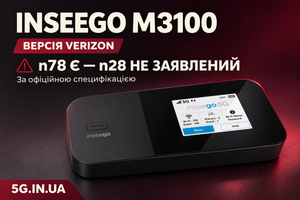
The M3100 Verizon specifications include n78 but do not list n28. This does not mean complete incompatibility with Ukrainian 5G. However, those specifications do not meet a requirement for both bands.
If a location offers 5G only through n28, a device lacking n28 cannot use that connection. Compatible LTE may still provide internet, but through 4G.
This limitation is examined in why the M3100 Verizon without n28 is a poor choice for future deployment.
Do not substitute similar labels for the required bands
LTE B28 does not establish 5G n28 support. Look for n28 in the 5G NR list.
n71 does not replace n28. It is a different band.
5 GHz Wi-Fi is not mobile 5G. It describes the local wireless connection.
SIM unlocking does not prove support for new bands. It concerns a carrier restriction, not an automatic expansion of radio capabilities.
“Global,” “modified firmware” and “for all operators” do not replace an exact specification.
Both bands are necessary for this requirement, but not a complete guarantee
A band list must be supplemented with checks of NSA/SA modes, relevant LTE–NR combinations for NSA, firmware and operator compatibility.
Supporting both bands also does not mean the device can aggregate them simultaneously. That is a separate capability.
The documentation covering the European M2000 version lists n78 and n28. This demonstrates why the exact variant must be checked: one version’s specifications must not be attributed to another.
What to request before paying
Obtain the exact model and SKU, matching official specifications and firmware version. For an available network, request evidence of an actual connection. For a future band, rely on documentation rather than a promise to “enable it later.”
Do not buy Novatel / Inseego for 5G in Ukraine—that is our editorial recommendation for buyers seeking to avoid choosing the wrong version. The universal rule for every brand is this: if you are buying for n78 and n28, both must be confirmed before purchase.
Neither a discount nor an impressive “5G” label compensates for a missing capability.