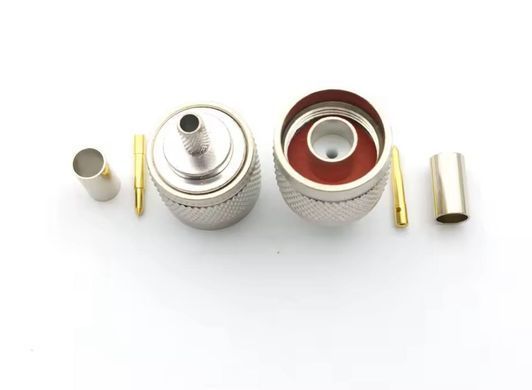
N-Male Crimp Connector (Solder + Crimp) for RG58 / LMR195 / RG400
This N-Male crimp connector (solder + crimp type) is a reliable RF solution designed for high-frequency coaxial connections up to 6 GHz (and up to 11 GHz with precision assembly). It is ideal for assembling antenna or interconnect cables using RG58, LMR195, or RG400 cables. Thanks to its standard N-type form factor, the connector ensures stable contact, mechanical durability, and resistance to environmental impact.
The body is made from nickel-plated brass, providing excellent corrosion resistance and high electrical conductivity. The internal dielectric is made of PTFE (Teflon), allowing the connector to operate in a wide temperature range from -55 °C to +155 °C. The center conductor of the cable is soldered, which minimizes signal loss and enhances long-term electrical reliability at high frequencies. The cable braid is secured using a crimp sleeve, ensuring low contact resistance and minimal signal attenuation.
With a characteristic impedance of 50 Ohms, this connector is compatible with a wide range of modern RF and telecommunications applications — including Wi-Fi, mobile networks, radio systems, and general RF use. When properly assembled, it can maintain a VSWR of up to 1.3:1 up to 3 GHz, making it suitable even for demanding signal chains.
It supports up to 500 mating cycles without significant degradation of contact quality. With the addition of an O-ring (if present), the connector can be sealed to IP67 for moisture and dust resistance.
Applications:
-
Antenna cable fabrication and repair
-
High-frequency equipment connection
-
Field cable terminations
-
FPV, SDR, and RF communication projects
Key Features:
-
Combined solder + crimp design for secure, low-loss connectivity
-
Stable 50 Ohm impedance across a wide frequency range
-
Compatible with RG58, LMR195, RG400 cables
-
High durability under mechanical and thermal stress
-
Industrial-grade brass construction with nickel plating
Suitable for both DIY and professional RF setups where signal integrity and mechanical robustness are critical.