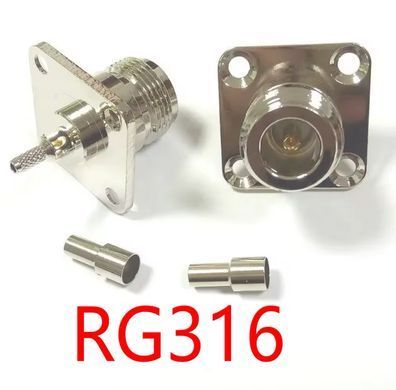
N-Female Flange Connector for RG316 / RG174 / LMR100 Cable (Solder Type)
The N-Female flange connector is designed for secure connection of thin coaxial cables such as RG316, RG174, or LMR100 to antennas, enclosures, or RF equipment. With a solderable contact system and a rigid 25×25 mm flange mount, this connector provides excellent electrical stability, low insertion loss, and long-term durability in environments exposed to vibration, moisture, or temperature fluctuations.
The four-hole 25×25 mm flange base ensures firm mechanical fixation on metal or plastic panels, preventing any loosening or signal disruption during operation. This makes the connector a solid choice for industrial, field, or defense applications, where robust mounting and electrical integrity are essential.
The body is made from nickel-plated brass for corrosion resistance, with a gold-plated center pin that ensures clean RF conductivity. The PTFE (Teflon) dielectric guarantees thermal stability and low dielectric loss, supporting operation up to 6 GHz while maintaining minimal VSWR across the band.
Technical Specifications:
-
Compatible cables: RG316, RG174, LMR100 (flexible, ~2.5 mm Ø)
-
Connection method: Solder (center and shield)
-
Mounting type: Flange, 4-hole, base size 25 × 25 mm
-
Impedance: 50 Ohms
-
Operating frequency range: up to 6 GHz (mechanically rated to 11 GHz)
-
Max power handling:
-
Materials: Nickel-plated brass, PTFE insulator, gold-plated contact
-
Temperature range: –55°C to +155°C (depending on cable used)
Typical Applications:
-
Wi-Fi 2.4/5.8 GHz antenna systems
-
4G/5G modules, routers, repeaters
-
SDR equipment and RF measurement setups
-
Compact IoT / LoRa devices and enclosures
-
Radio electronics in weatherproof or embedded systems
This connector is engineered for use where compact size, long-term reliability, and high-frequency performance are essential. It is optimized for thin, flexible coaxial cables commonly used in portable communication devices, compact antennas, and field-ready RF modules.
The solid mechanical design, electrical precision, and ease of panel mounting make it an essential component in any RF project where performance cannot be compromised.